

Ever seen a digital screen that looks and acts just like paper? You can write something on it, and the image stays put—no battery, no plug, no power needed at all. That’s the core idea behind E Ink signage, a display technology that’s quickly becoming a go-to solution in retail, public transport, and even smart city projects.
What Is E Ink Signage and Why Does It Matter?
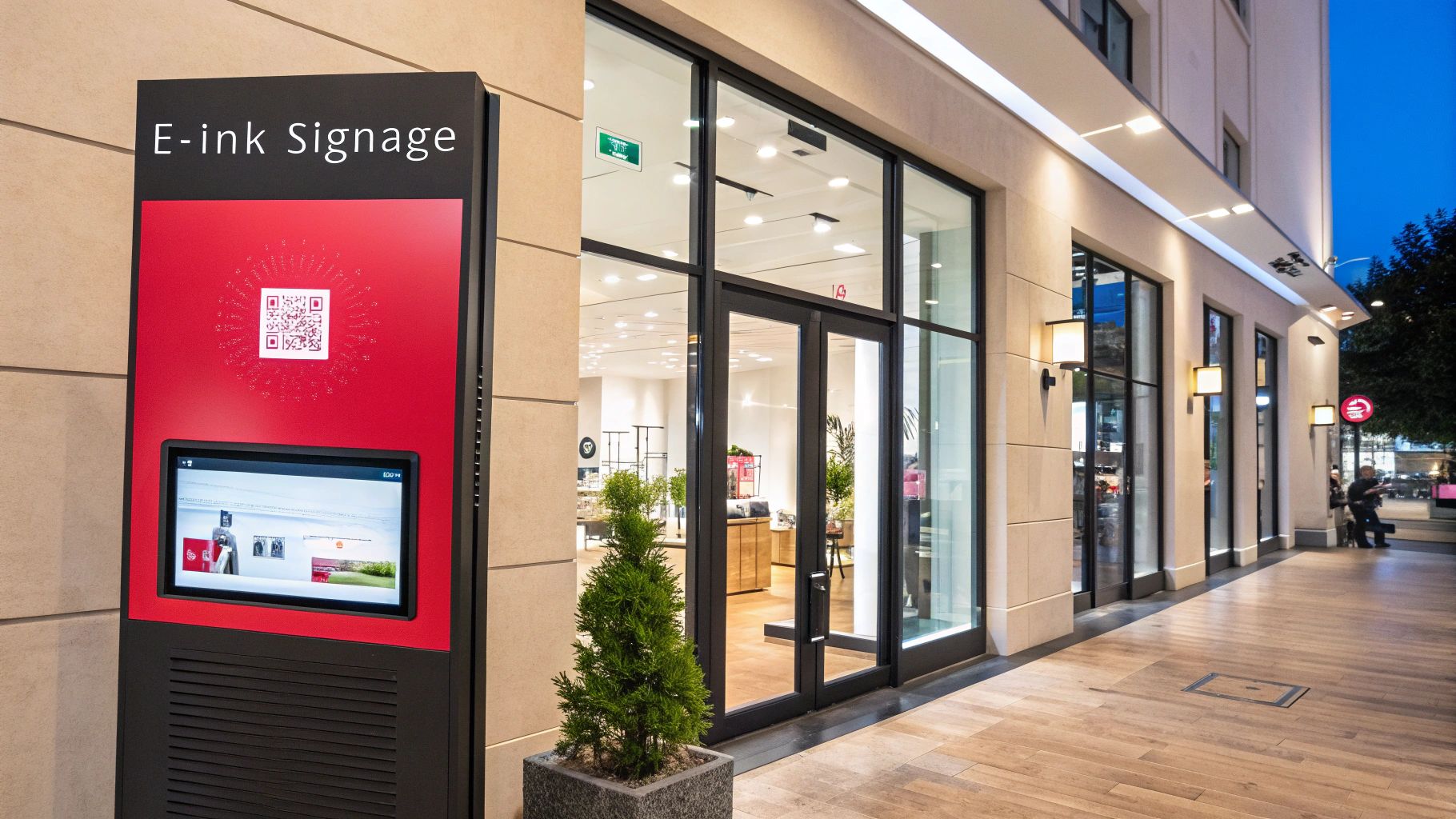
Unlike the LCD or LED screens in your phone or TV that need a constant backlight to stay on, E Ink—or what engineers call an electrophoretic display (EPD)—is completely different. It's built from millions of tiny microcapsules, each one containing positively charged white particles and negatively charged black particles floating in a clear fluid.
When a small electric field is applied, the particles move. A positive charge pulls the black particles to the surface, creating your text and images. A negative charge does the opposite, bringing the white particles up to form the background. It's a simple, physical change.
The real magic here is a feature called bistability. Once the particles are arranged, they lock into place and stay there without using any more power. The display only sips energy for that brief moment when the content is updated. Think of it like a whiteboard: it only takes effort to write or erase, not to keep the message visible.
The Rise of a Sustainable Display Solution
This incredibly low-power design is exactly why E Ink signage is gaining so much ground. Businesses are constantly looking for ways to cut operating costs and hit their sustainability goals, and E Ink provides a clear, practical answer. Its minimal energy use means lower electricity bills and a much smaller carbon footprint compared to constantly-on, power-hungry backlit displays.
And the market is noticing. The E-Ink signage market is on track to hit around $500 million in 2025 and is set to grow at a healthy 15% Compound Annual Growth Rate (CAGR) from 2025 to 2033. This growth is all about the demand for low-power, eco-friendly screens that look great even in bright sunlight. You can dive deeper into the research on the E Ink market's future growth for more details.
To really get why this technology is a big deal, let's stack it up against the screens we're all used to.
E Ink Signage vs Traditional Digital Displays at a Glance
This quick table breaks down the fundamental differences between E Ink and traditional LCD/LED displays. It’s not about one being "better" than the other, but about choosing the right tool for the right job.
| Feature | E Ink Signage | LCD/LED Displays |
|---|---|---|
| Power Consumption | Ultra-low (only uses power to change the image) | High (requires constant power for backlight) |
| Sunlight Readability | Excellent (reflective, just like paper) | Poor to fair (suffers from glare and washout) |
| Viewing Experience | Stable, no flicker, easy on the eyes | Can cause eye strain due to backlight and refresh rate |
| Best Use Case | Static or semi-static content (prices, schedules) | Dynamic, high-motion video content |
| Heat Emission | Virtually none | Generates significant heat |
| Power Source | Can run on batteries or solar for years | Requires a constant connection to the grid |
As you can see, each technology has its strengths. E Ink is a specialist—built for clarity, efficiency, and environments where traditional screens just can’t compete.
Key Characteristics Defining E Ink Signage
A few core features really set E Ink apart and make it the perfect choice for certain jobs.
- Exceptional Readability: E Ink screens are reflective, using ambient light to make the image visible—just like ink on paper. This means no glare, making them perfectly readable in direct sunlight where other screens become useless.
- Static Content Excellence: Since there's no refresh rate or flicker, the image is completely stable and easy on the eyes. This is ideal for displaying information that doesn't change every second, like timetables, retail price tags, or public notices.
- Unmatched Energy Efficiency: The ability to hold an image with zero power opens up a world of possibilities. You can deploy signs powered by a small battery or solar panel in places where running electrical wiring would be impossible or too expensive.
This mix of paper-like visuals, extreme energy savings, and fantastic outdoor readability makes E Ink signage a powerful communication tool. It's a technology that solves real-world business problems while fitting perfectly with modern goals for sustainability and smarter operations.
The Core Advantages of E Ink Technology
While the science behind E Ink is pretty cool, what really matters in the real world are the tangible benefits it brings to a business. We’re not talking about small, incremental improvements here. This technology fundamentally changes how companies can communicate visually, unlocking opportunities that were once either impossible or just way too expensive.
It really boils down to three game-changing strengths: incredible energy efficiency, perfect readability in any light, and major long-term cost savings. These perks aren't just happy accidents; they’re all direct results of E Ink’s unique bistable technology. Once you see how they all work together, it’s clear why so many industries are making the switch.
Unmatched Energy Efficiency
The biggest headline-grabber for E Ink signage is its jaw-droppingly low power consumption. This isn’t a slight edge—it’s a complete rethinking of how a digital display even uses energy. Your standard LCD screen is a power hog, needing a constant backlight just to keep the image visible.
E Ink, on the other hand, is bistable. The best analogy is a classic whiteboard. You only use energy when you write on it or wipe it clean. Once your message is up, it just… stays. No power needed. E Ink displays work on the exact same principle, sipping a tiny bit of power only when the content on the screen changes.
This means an E Ink sign can hold a static image for weeks, months, or even years on a single, small battery. It completely opens up the playbook for where you can put a sign—think remote bus stops or sprawling warehouses where running electrical wiring would be a nightmare.
Perfect Sunlight Readability and Visual Comfort
Ever tried to read your phone screen at the beach? The sun’s glare completely washes it out, making it almost useless. That’s because emissive displays, the kind that make their own light, are basically in a losing battle with the sun.
E Ink signage plays by a different set of rules. It’s a reflective display, meaning it uses the light around it to make the image visible—just like a piece of paper. This is huge for two reasons:
- Zero Glare: The brighter the sunlight, the clearer the E Ink image actually becomes. This makes it the perfect choice for outdoor signs, public transport schedules, and retail displays that sit in a sunny window.
- Easy on the Eyes: With no backlight, there’s no annoying flicker or harsh blue light. The viewing experience is as comfortable as reading a book. This is why e-readers took off, and it’s just as critical for public information displays that people glance at all day long.
Bottom line: your message is always sharp and easy to read, no matter the lighting.
Sustainability and Lower Operating Costs
That extreme energy efficiency isn’t just a cool party trick; it translates directly into serious financial and environmental wins. By using up to 99% less power than a comparable LCD screen, the hit to your operating budget is smaller and a lot more predictable.
And lower electricity bills are just the beginning. The ability to run these signs on small solar panels or batteries that last for years means you can skip the expensive electrical work and ongoing maintenance. Put it all together, and you’re looking at a much lower total cost of ownership over the sign’s life.
This efficiency is also a big deal for any company serious about sustainability. A smaller carbon footprint is a clear win for corporate responsibility goals and resonates with today's customers. It’s a major reason for the explosive growth across the entire E Ink ecosystem, from e-readers to the electronic shelf labelling you see in modern stores.
The numbers don’t lie. The market was valued at USD 1.73 billion in 2023 and is on track to hit USD 4.56 billion by 2032. Choosing E Ink is a smart investment in efficiency, visibility, and a greener future.
How Industries Use E Ink Signage in the Real World

The theory behind E Ink is great, but its real value shines when you see it solving actual problems out in the wild. Across all kinds of industries, this technology is being rolled out to slash costs, make communication clearer, and pull off things that just weren't practical before. From the fast-paced floor of a retail store to remote bus stops, E Ink is proving its worth time and again.
By far, the most common and impactful place you'll see this tech is in retail, where speed and accuracy are everything.
Revolutionizing the Retail Experience
For any retailer, managing prices and promos across thousands of products is a never-ending, hands-on nightmare. Paper labels are just asking for human error, they burn through employee hours on manual updates, and they lead to those awkward moments at checkout when prices don't match. Electronic Shelf Labels (ESLs), which are powered by E Ink, tackle these problems head-on.
Instead of sending staff around to swap out countless little bits of paper, a store manager can push price updates and launch promotions across the entire store from a single computer. The change is almost instant, making sure shelf prices always match the checkout system and online store. This doesn't just save thousands of labor hours a year; it also dodges the hefty fines that can come from pricing mistakes.
But it's about more than just the price tag. These dynamic labels can do so much more:
- Stock Levels: Show shoppers and staff real-time inventory at a glance.
- Promotional Details: Flash a special offer or bundle deal right where it matters most.
- Product Information: Display QR codes that link to customer reviews, nutritional info, or where a product came from.
This level of control gives retailers the agility to react to market shifts, manage stock more effectively, and seriously upgrade the customer experience. To really get how it all works, you can learn more about how electronic shelf price tags work and see the underlying tech in action.
Powering Smart Transportation and Public Services
The world of public transport has a unique headache: getting real-time, accurate info to people outdoors, where power is hard to come by and bright sunlight can make screens unreadable. E Ink signage is a perfect fit. Its incredible readability in direct sun and ridiculously low power needs make it a natural for these tough spots.
Think about a city bus stop. Running power cables to every single stop in a metro area is a non-starter financially. With E Ink, transit agencies can set up solar-powered signs that show live arrival times, service alerts, and route changes. These signs can run on their own for years, providing a crucial service without the massive infrastructure spend.
The same idea works for airport gates, train platform schedules, and parking garage signs. The information is always sharp and clear, even with the sun beating down on it, and the tiny power draw means they just keep working, day in and day out.
This technology is also a huge piece of the puzzle for broader smart city projects. Cities are using E Ink for public information boards, interactive wayfinding, and emergency alerts. Because they don't need to be tied to the grid, these signs can be installed exactly where people need them most, improving public safety and communication without blowing the budget. It's a great example of how E Ink fits into larger commercial real estate technology strategies focused on efficiency and sustainability.
Other Growing Applications for E Ink
The sheer flexibility of E Ink means it's popping up in a lot of other places, too.
- Healthcare: Patient room signs are being updated remotely with dietary notes, doctor info, and care plans, which improves communication and cuts down on mistakes.
- Corporate Offices: Meeting room displays show who has the room booked and for how long, syncing right up with calendar software to kill booking headaches.
- Logistics and Warehousing: Big E Ink displays on loading docks and down warehouse aisles give workers clear, current instructions, making the whole workflow smoother.
In every one of these cases, the core benefits are the same: delivering clear, changing information in a super-efficient and sustainable way.
Getting Your E Ink Signage Deployment Right
Rolling out e ink signage successfully is about much more than just picking a cool-looking display. If you want your signs to be reliable, simple to manage, and actually deliver a return on your investment, you need a solid plan. That means thinking about the entire ecosystem—the software, the network connection, and even the power source.
Breaking it all down from the start helps you sidestep those frustrating (and expensive) headaches later. How will you push updates? How will the signs connect to your network? Can they stand up to the weather? Nailing these details early makes all the difference.
Choosing Your Content Management System
The Content Management System (CMS) is the brain of your whole e ink operation. It's the software that lets you design, schedule, and send updates to all your displays, whether you have one screen or a thousand of them. A good CMS transforms your signs from static displays into a dynamic, centrally-controlled communication tool.
When you're looking at different CMS options, keep an eye out for these must-have features:
- Remote Management: You absolutely need the ability to update content from anywhere, without ever having to physically touch the sign.
- Smart Scheduling: This is key for timing your messages perfectly. Think changing menu prices right before the lunch rush or launching a new promotion at the exact start of a sale.
- A Simple Interface: The dashboard should be intuitive enough for a store manager or marketing team member to use without needing a degree in IT.
- Easy Integration: Look for a system that can talk to your other business tools, like inventory management or point-of-sale (POS) systems, to make content updates automatic.
The right CMS makes managing your content a breeze, not a logistical nightmare. Many of the same planning principles for electronic shelf labels apply here; checking out the benefits of electronic shelf labels can give you a better sense of how a powerful backend system drives efficiency.
Picking the Right Connectivity and Power Solutions
So, how will your signs get their marching orders? E ink signage is flexible, with a few different connectivity options to fit any situation. Your choice really comes down to where you're putting the sign and what infrastructure you have available.
- Wi-Fi: This is the no-brainer for indoor spots like retail stores, lobbies, or offices where you already have a solid wireless network. It’s simple and cost-effective.
- Cellular (4G/5G): Got a sign going up where Wi-Fi can't reach? A bus stop or a park kiosk, for instance? Cellular gives you a rock-solid connection just about anywhere.
- Wired (Ethernet): For permanent, high-stakes installations where you can't afford any connection drops, a physical cable is still the most stable and secure option.
Because E Ink is so incredibly power-efficient, you can often run these signs completely off the grid. Just imagine pairing a cellular-connected sign with a small solar panel—you’ve just created a totally self-sufficient unit. It’s the perfect setup for remote bus schedules or trail markers where running electrical lines would be a massive expense.
Don't Forget Environmental Durability and Weatherproofing
If your E Ink sign is going outside, it has to be tough. Period. These displays need to be engineered to handle whatever Mother Nature throws at them—rain, dust, humidity, and crazy temperatures. This is where IP ratings (Ingress Protection) become a really big deal.
An IP rating is just a simple, two-digit code that tells you how well a device is sealed against solids (the first digit) and liquids (the second). For example, a sign with an IP65 rating is totally dust-tight and can handle being sprayed with water jets from any direction.
Choosing a sign with the right IP rating is your insurance policy. It guarantees your display will keep working reliably for years, protecting your investment and making sure your message is always visible, rain or shine.
To help tie all these planning threads together, here's a quick checklist to guide your deployment strategy.
E Ink Deployment Checklist
Thinking through these areas systematically will help you build a robust and effective E Ink signage network from the ground up.
| Consideration Area | Key Questions to Ask | Best Practice |
|---|---|---|
| Content Strategy | What is the primary goal of our signs? Who is our audience? | Define clear objectives (e.g., promotions, information, wayfinding) before selecting hardware. |
| CMS Selection | Does it integrate with our existing systems (POS, inventory)? Is it easy for our team to use? | Prioritize a user-friendly CMS with strong API capabilities for future-proofing and automation. |
| Connectivity | Is reliable Wi-Fi available at all locations? Do we need a mobile/cellular backup? | Survey each site's network infrastructure. For mission-critical signs, consider dual-connectivity options. |
| Power Source | Is there easy access to an electrical outlet? Could solar power be a viable alternative? | For remote or outdoor locations, calculate the cost-benefit of a solar panel versus running new electrical lines. |
| Durability | What environmental conditions will the sign face (rain, sun, dust, temperature)? | Match the sign's IP rating and operating temperature range to the harshest conditions it will encounter. |
| Installation & Maint. | Who will handle the physical installation? What is the plan for long-term maintenance? | Develop a clear installation plan and partner with a provider that offers solid technical support and warranties. |
A well-planned deployment ensures your E Ink signs become a valuable asset, not a technical burden. By getting these details right upfront, you set yourself up for a smooth rollout and long-term success.
The Future of E Ink Innovations
While today's e-ink signage is already making a huge impact, the technology is far from done evolving. The next wave is pushing the boundaries of what's possible, taking us from simple, static displays to vibrant, intelligent surfaces that are literally built into the architecture around us. These advancements are set to make digital communication even more seamless and sustainable.
To really get a handle on what’s coming, it helps to see these developments as part of the bigger picture of key business technology trends. E-ink isn't just a screen technology anymore; it's becoming a foundational piece of smarter, more responsive environments.
The Evolution into Full Vibrant Color
One of the biggest leaps forward is happening in color. For a long time, e-ink displays were stuck with black, white, and maybe a splash of red or yellow. It worked great for price tags and schedules, but it was a non-starter for serious branding and advertising.
That's all changing, and fast. With advanced panels like E Ink Spectra 6, these displays can now produce a rich, full-color palette. The best part? They do it without giving up the core benefits we love: crazy-low power consumption and perfect readability, even in direct sunlight. Imagine retail promos or public art as vivid as a printed poster, but with the ability to be updated in an instant.
This jump to full color opens up a massive range of creative uses. It lets brands keep their colors perfectly consistent in marketing and makes for much richer, more engaging visual experiences in public spaces.
Bigger, Bolder, and More Flexible Formats
The ambition for e-ink signage is growing—literally. The technology is scaling up to create massive, low-power digital billboards and architectural displays. In fact, large-size e-ink displays are a rapidly growing market, projected to hit a global value of around $695 million in 2025.
We saw a major milestone in 2025 with the unveiling of a 75-inch full-color ePaper display, proving that large-format, high-res signage is no longer a dream. It's here.
But it's not just about size; flexibility is the next frontier. Researchers are developing e-ink displays that can be bent and shaped to fit curved surfaces. This could lead to dynamic displays woven directly into pillars, wrapped around vehicles, or molded into custom retail fixtures. It’s all about blending digital content seamlessly with the physical world.
Smarter Signage with AI and IoT Integration
This is where things get really exciting. The next evolution is making e-ink signage truly intelligent by connecting it with the Internet of Things (IoT) sensors and AI. Signs are becoming aware of and responsive to their immediate environment, creating a powerful feedback loop where the content on the screen adapts automatically based on real-time data.
Just think about the possibilities for smart e-ink signage:
- Retail Analytics: A sign could switch its promotional message based on the demographic data of the shoppers walking down the aisle right now.
- Dynamic Wayfinding: Public transit signs could automatically update directions based on live traffic congestion or event schedules.
- Responsive Public Information: An outdoor display could show weather warnings, pollen counts, or UV index alerts based on live sensor readings from its location.
This fusion of technologies turns a simple sign into an active participant in its surroundings, delivering incredibly relevant information exactly when and where it's needed most.
Common Questions About E Ink Signage
Like any technology that shakes up how a business runs, e-ink signage brings up some practical questions. Before making the switch, it’s smart to get a handle on the initial investment, what to expect in terms of performance, and how long these signs will really last.
Let's dig into some of the most common things businesses want to know before they jump in. This tech has a unique set of strengths, but it’s just as important to understand its limitations to make sure it lines up with what you’re trying to achieve.
What Is the Real Cost of E Ink Signage
Looking at the upfront cost, e-ink signage is usually more of an investment than traditional printed signs. Sometimes, the price tag can even be in the same ballpark as entry-level LCD screens. But here’s the thing: focusing only on that initial number misses the bigger picture entirely. The real value comes from its incredibly low total cost of ownership.
The return on investment (ROI) with e-ink signage comes from massive operational savings. Since the displays use practically zero power unless the content is being updated, energy costs plummet—often by up to 99% compared to a backlit LCD.
On top of that, you get to say goodbye to all the recurring costs that come with paper signs:
- Labor Costs: No more pulling staff off the floor to manually swap out paper labels or posters.
- Material and Printing Costs: The endless cycle of printing, shipping, and throwing away paper signs is over.
- Reduced Errors: Updates are instant and accurate, pushed from one central system, which prevents costly pricing mistakes.
When you add up these savings over a few years, that initial investment often pays for itself and then some.
Can E Ink Displays Show Video
This one comes up a lot. The short answer is no—e-ink technology isn't built for full-motion video. Its superpower is bistability, which is a fancy way of saying it can hold an image on the screen without using any power. The process of changing the image involves physically moving tiny ink particles around, which means its refresh rate is much slower than an LCD or LED.
Think of it more like turning the page in a book instead of watching a movie. That deliberate, slow refresh is perfect for content that only needs to change every so often, like:
- Retail prices and promotions
- Bus and train schedules
- Meeting room availability
- Wayfinding maps and directories
The technology is at its best when displaying static or semi-static content with incredible clarity and efficiency. For a deeper dive into what digital labels can do, this digital label FAQ has a great overview.
How Long Do E Ink Signs Last
E-ink displays are built to be workhorses. The panels themselves are incredibly tough, with a typical lifespan rated for millions of updates. In the real world, this means a sign updated a few times a day can easily last for five to seven years or more, though it depends on the model and where it's being used.
For outdoor signs, the casing is just as critical as the screen inside. Good manufacturers build their signs with high IP ratings—look for IP65 or IP67—which means they’re sealed tight against dust, rain, and humidity. These tough, weatherproof designs protect the electronics and keep the sign running reliably, even in harsh weather, making them a solid long-term investment.
Article created using Outrank


Leave a Reply
Your email is safe with us.