

Ever had that frustrating moment at checkout when an item rings up for a different price than what was on the shelf? Electronic shelf tags are designed to make that problem a thing of the past.
Think of them as small, digital screens that take the place of old-school paper price labels. They connect to a central store system, allowing a manager to update prices on thousands of products at once, instantly. This simple idea gets rid of a ton of manual work and, more importantly, ensures the price you see is the price you pay.
What Are Electronic Shelf Tags
Switching from paper price tags to electronic shelf tags (ESLs) is like upgrading from a flip phone to the latest smartphone. It’s not just a minor improvement; it’s a complete change in how stores handle their most important piece of information: the price.
For decades, retailers have wrestled with the tedious and mistake-prone task of changing paper tags by hand. Every sale, price drop, or product update meant someone had to print a new label, walk the aisles, find the right spot, and swap it out. It's a slow, expensive process that often leads to pricing mistakes, which can really damage customer trust and even cause legal headaches.
The Core Function of Digital Tags
Electronic shelf tags fix this by creating a smart, connected network right on your store shelves. Each tag is a tiny digital display, typically using the same e-paper technology found in e-readers. This is key because it uses very little power, allowing the batteries inside to last for 5-10 years.
These tags talk wirelessly to a central computer in the store. When an employee updates a price in the main system (like the point-of-sale or inventory software), that new price is beamed out to the correct tag on the shelf. The display updates automatically within seconds.
This creates perfect harmony between the shelf edge and the checkout counter. For any business juggling a huge number of products, exploring the different kinds of retail store shelf labels is the first real step toward running a modern, efficient operation.
The goal here is 100% price accuracy. It's the foundation of a good shopping experience. When the price on the shelf matches the price at the register, it builds confidence and keeps customers coming back.
More Than Just a Price Display
While displaying the price is their main job, modern electronic shelf tags can do so much more. They’ve become a powerful tool for improving store operations and helping shoppers.
- Promotional Information: They can flash a sale price, show the original price next to the discounted one, or display bulk-buy offers like “2 for $5.”
- Product Details: Tags can show how many items are left in stock, a QR code that links to online reviews, or even critical information like allergen warnings.
- Operational Efficiency: For store staff, these tags are a huge help. They can display product codes or other data that makes restocking shelves and counting inventory much faster.
By taking over the chore of price changes and offering a platform for all kinds of dynamic info, ESLs have become a must-have for retailers who want to compete and run a smarter store.
How Do Electronic Shelf Labels Actually Work?
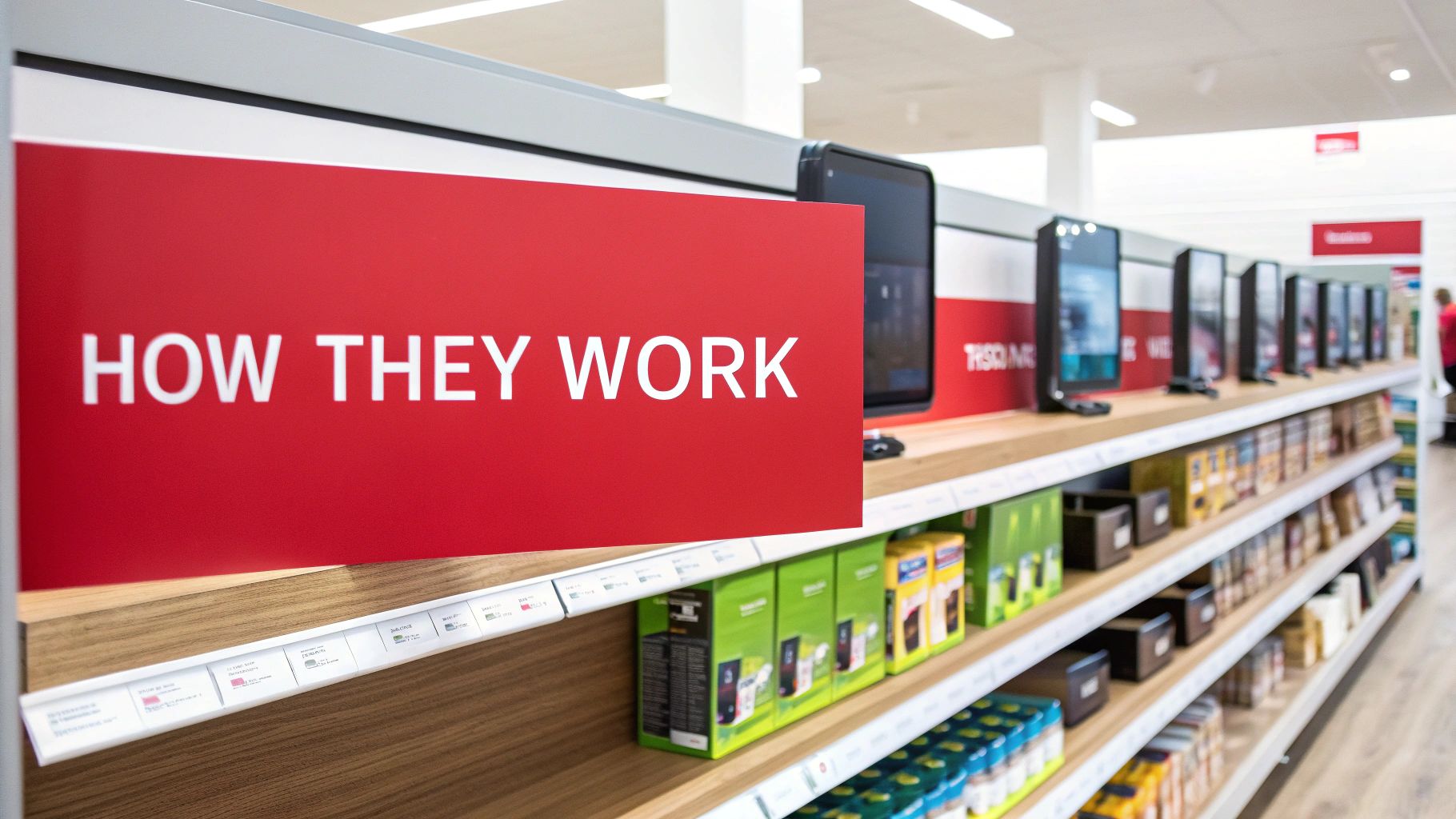
To really get why electronic shelf labels are such a big deal, you have to peek behind the curtain. Think of an ESL system less like a bunch of individual gadgets and more like a dedicated nervous system for your store's pricing. It's built for one mission: to get the right price and product info to the right shelf, right now.
This whole operation is a seamless dance between three key pieces of technology working together. Once you see how they connect, you'll understand how a price change on your computer can show up on the shelf edge in seconds.
The Three Core Components of an ESL System
The magic of an ESL system isn't really magic at all—it’s just a smart, simple design. Each part has a clear job, creating a reliable path for information to travel from your back office to the customer's eyes.
- The Digital E-Paper Tags: These are the faces of the operation—the small screens you see on the shelves. They run on e-paper (or e-ink) technology, just like a Kindle. This is a brilliant choice because e-paper only sips power when the screen changes. Once an update is made, it holds the image using zero battery, which is why these tags can last an incredible 5 to 10 years on a single battery.
- The Wireless Communication Network: The tags don't just hop on your store's Wi-Fi. That would be chaotic. Instead, they use their own private, low-power network that operates on radio frequency (RF). Small transmitters, which look a lot like Wi-Fi routers, are placed strategically around the store. These "access points" catch signals from the central software and broadcast them out to the tags.
- The Central Management Software: This is mission control. It’s the software dashboard where your team sets prices, tweaks tag layouts, and keeps an eye on the whole system's health. It’s the brain that tells the network what information to send and exactly which tag needs to get it.
Together, these three parts form a closed-loop system that’s secure, efficient, and built from the ground up for the tough retail environment.
The Journey of a Price Update
So, how does a price change actually happen in the real world? Let’s say you want to run a weekend sale on a popular brand of cereal.
It all starts in the central management software. A manager logs in, finds the cereal, and enters the new sale price. The moment they hit "update," the software packages that command into a tiny data packet.
Think of this data packet like a digital memo. It contains everything the tag needs to know: the new price, the unique ID of the specific tag it’s going to, and how the new info should look on the screen.
The software zips this memo over to the nearest wireless access point. The access point then broadcasts the signal, and the one specific tag with the matching ID catches it. It "reads" the memo and instantly refreshes its screen with the new price. The entire trip, from click to change, takes just a few seconds.
Seamless Integration with Your Existing Store Systems
An ESL system that stands alone is helpful, but one that talks to your other software is a true game-changer. Modern ESL platforms are designed to plug right into the tools you’re already using.
- Point of Sale (POS) Systems: This is the most critical link. When a price is changed in your POS, the ESL software sees it and automatically pushes the update to the shelf. This is how you achieve 100% price accuracy between the shelf and the checkout. No more mismatches.
- Inventory Management Systems: By connecting to your inventory software, tags can show real-time stock information. A tag could automatically flash "Low Stock" or even display the exact number of items left on the shelf.
- Enterprise Resource Planning (ERP) Software: For bigger operations, an ERP integration ensures pricing and product data stay consistent across the entire business, from the warehouse to the sales floor.
This deep integration creates a single source of truth for your data, getting rid of manual data entry and all the human errors that come with it. If you're curious about the deeper technical details, you can learn more about how electronic shelf price tags work in our detailed guide. This interconnectedness is what elevates ESLs from a simple display to a core part of running a smarter, more agile business.
The Strategic Benefits of Adopting ESLs
Thinking about electronic shelf tags as just a cool gadget to modernize your shelves misses the bigger picture. In reality, switching to ESLs is a major strategic move that pays off in ways you can see and measure. The benefits create a positive ripple effect, touching everything from daily store operations to customer loyalty and your ability to outmaneuver the competition.
These powerful impacts really fall into three main categories, each one representing a core area where electronic shelf tags deliver a serious return on investment.
Drive Operational Excellence
The most immediate win you'll see from ESLs is in your day-to-day store operations. It’s all about swapping out tedious manual work for smart automation, which translates directly into saving time, money, and headaches.
A huge part of this is the contribution ESLs make to automating business processes, completely changing the game for price updates and promotions. Just think about the hours your team spends printing, cutting, and swapping out tiny paper labels, aisle by aisle. An ESL system vaporizes that entire task. This frees up your staff to do what they do best: helping customers, managing stock, and making the store a better place to shop.
This automation also solves one of retail's most persistent problems: pricing errors. A single wrong paper tag can lead to an unhappy customer, a lost sale, or even legal trouble.
With an electronic shelf tag system, you get 100% price accuracy between the shelf and the checkout. You stop losing money from underpriced items and protect your store's good name by never overcharging a customer.
Enhance Customer Satisfaction
A great shopping experience is built on trust, and nothing breaks that trust faster than a price scanning incorrectly at the register. ESLs eliminate this major point of friction, but their positive impact on the customer's journey doesn't stop there.
These little screens can do so much more than just show a price. For example, they can:
- Highlight Promotions: Clearly display the original price next to the sale price so shoppers immediately see the value.
- Show Stock Levels: An alert like "Low Stock" can create a sense of urgency or help a customer decide to buy now.
- Offer More Info: A quick scan of a QR code can pull up reviews, how-to videos, or allergy information right on a shopper’s phone.
By putting clear, accurate, and genuinely helpful information right where customers make their decisions, electronic shelf tags create a smarter and far more satisfying shopping trip. You can find out more about the specific benefits of electronic shelf labels and how they build shopper trust in our dedicated article.
Unlock Strategic Agility
In a fast-moving retail environment, the ability to adapt on the fly is your secret weapon. This is where an ESL system truly shines, giving you a level of strategic flexibility that's impossible with paper. The key here is dynamic pricing.
With electronic tags, you can change prices across hundreds of stores in a matter of minutes, not days. This opens up a whole new playbook of strategic options:
- React to Competitors: Instantly match a competitor’s surprise sale.
- Price Based on Demand: Adjust prices for popular items during peak shopping times.
- Automate Markdowns: Program gradual price drops for items like fresh produce to reduce waste and capture more sales.
- Run Flash Sales: Launch a powerful, short-term promotional event with the click of a button.
This level of control gives you the power to maximize revenue and react instantly to what's happening in the market. It’s a major reason why the global market for these devices is growing so fast. The Electronic Shelf Edge Label (ESL) market is set to jump from USD 1422 million in 2025 to USD 3295 million by 2031, growing at a compound annual rate of 15.0%. This massive adoption is a direct result of the clear operational and strategic wins they deliver.
Paper Labels vs Electronic Shelf Tags A Comparison
To really see the difference, it helps to put the old and new methods side-by-side. The contrast in efficiency, accuracy, and capability is stark.
| Feature | Paper Labels | Electronic Shelf Tags |
|---|---|---|
| Update Speed | Extremely slow (hours or days) | Instant (seconds or minutes) |
| Labor Cost | High; requires constant manual updates | Minimal; updates are automated and centralized |
| Accuracy | Prone to human error | 100% accurate; syncs directly with the database |
| Customer Info | Limited to price, maybe a unit price | Can display promotions, stock, QR codes, & more |
| Dynamic Pricing | Impossible to implement effectively | Easy to execute for strategic initiatives |
| Waste | Generates significant paper and ink waste | Reusable and eco-friendly |
Ultimately, while paper labels have served their purpose, they simply can't keep up with the demands of modern retail. Electronic shelf tags are a fundamentally smarter, more efficient, and more powerful tool for any retail business.
Where Smart Tags Are Making a Real Difference
The true value of electronic shelf tags really clicks when you see them solving everyday problems. This technology isn't just a fancy way to show a price; it’s a practical tool that businesses are using to become smarter and more efficient. From a busy supermarket aisle to a sterile hospital corridor, these little screens are fundamentally changing how information is shared.
Let's move past the theory and look at how this plays out in the real world. These examples show how different industries took a specific challenge and found an elegant, effective solution in ESLs. Their adaptability is what makes them so powerful—they're much more than just a retail gadget.
Reinventing the Retail Experience
In the hyper-competitive world of retail, creating a better shopping trip is everything. Electronic shelf tags are a game-changer here, turning static shelves into dynamic, helpful spaces for both customers and staff.
Picture yourself in a large electronics store. Instead of a simple price tag next to a new camera, the digital label displays key specs like megapixels and battery life. It also has a QR code. A quick scan with your phone could pull up a professional video review or a link to buy compatible accessories, helping you make a confident decision right there and then.
Or think about a fashion store at the end of the season. Manually marking down hundreds of items is a tedious job filled with potential mistakes. With an ESL system, the manager can schedule automated, store-wide price drops on an entire collection with just a few clicks. Every tag updates at once, perfectly in time for a big weekend sale.
This level of control means retailers can be proactive. Instead of spending hours on manual updates, staff can focus on merchandising and helping customers—activities that actually grow the business.
Beyond the Shopping Cart: How Other Industries Are Upgrading Operations
The usefulness of electronic shelf tags doesn't stop at the retail checkout. Any place that depends on accurate, frequently updated information can benefit from this technology. The core principles of efficiency and accuracy are universal.
- Logistics and Warehousing: In a massive distribution center, ESLs serve as smart bin labels. Forget paper slips that get torn or become outdated. Digital tags can display part numbers, quantities, and even pick-orders, which drastically cuts down on errors and speeds up fulfillment.
- Healthcare Facilities: Hospitals use these displays outside patient rooms for crucial, real-time updates. A tag might show a patient's name, dietary restrictions, or important alerts for staff (like "Fall Risk"). This information can be changed instantly from the nurse's station, boosting both patient safety and team communication.
- Manufacturing Plants: On the factory floor, ESLs act as digital job cards at assembly stations. They show instructions, component lists, and production goals for the current task, and update automatically as a product moves down the line.
The Grocery Store: A Perfect Ecosystem
If you want to see the full potential of electronic shelf tags, look no further than your local supermarket. With thousands of products, constant promotions, and perishable items, grocery stores face operational headaches that ESLs are perfectly built to solve.
For example, a store can use dynamic pricing to automatically lower the price of fresh bread near closing time, which helps reduce food waste and captures a few extra sales. For a deeper dive into this specific application, our guide on digital labels for supermarkets offers detailed insights on how grocers are getting the most out of their systems.
The technology behind ESLs is a key part of the Internet of Things (IoT). For businesses looking into the wider world of connected devices, it's worth learning more about Managed IoT services. It shows how smart tags fit into a bigger trend of creating connected, automated business environments. From the grocery store to the factory floor, the possibilities are proving to be endless.
How to Calculate Your Return on Investment
Switching to electronic shelf tags is a serious investment. And like any big business decision, it has to make sense on paper. Calculating your Return on Investment (ROI) isn't just a formality to get the expense approved; it’s how you build a rock-solid business case showing exactly when this technology stops being a cost and starts making you money.
To figure this out, you have to look past the initial price tag. The real calculation involves balancing the upfront costs against all the financial gains you'll see down the road. It's a two-sided equation: what you spend versus what you save and what you'll earn.
Tallying Up the Initial Investment
First things first, let's talk about the costs. You need a complete picture of your initial spend to get an accurate ROI. While the tags themselves are a big part of it, they’re far from the only line item.
You'll need to account for several key components:
- Hardware Costs: This is more than just the tags. It includes the wireless access points that let them communicate, plus any servers or mounting gear.
- Software Licensing: The software that powers the whole system typically has a licensing fee, which might be a one-time purchase or an ongoing subscription.
- Installation and Setup: It's smart to factor in professional installation to make sure your network is solid and covers every corner of the store.
- Training and Integration: Don't forget the time and resources it takes to get your team up to speed and to sync the ESL system with your existing point-of-sale or inventory management software.
Getting a detailed quote that spells out all of these items is your starting point. For a deeper dive into these expenses, our guide on electronic shelf tags cost breaks it all down.
Quantifying the Financial Gains
Now for the fun part—seeing where the ESL system really shines. The financial upside comes from two places: direct cost savings (money you're no longer spending) and increased revenue (new money coming in).
The core idea is simple: You are trading a variable, ongoing labor cost for a fixed, one-time technology investment. Over time, the technology not only pays for itself but also unlocks new ways to boost sales.
Let's look at the main areas where you'll see a financial return:
- Labor Savings: This is the most obvious win. Figure out how many hours your team spends every single week printing, cutting, and manually swapping out paper tags. Multiply those hours by their pay rate, and you’ve got your annual labor cost for pricing. With ESLs, that cost all but vanishes.
- Elimination of Pricing Errors: Research has shown that manual pricing can have an error rate as high as 10%. Even a tiny error rate adds up to real losses, whether from under-priced items walking out the door or frustrated customers finding over-priced ones. ESLs give you 100% accuracy, protecting both your profit margin and your reputation.
- Revenue from Dynamic Pricing: Imagine running a flash sale with the click of a button, instantly matching a competitor's price drop, or automating markdowns on items nearing their expiration date. These strategies create new revenue. Even a small sales lift from this kind of agility can become a huge number over the course of a year.
This isn't just theory; the global retail market is voting with its wallet. The market for electronic shelf tags was valued around USD 1.95 billion in 2024 and is on track to hit USD 5.91 billion by 2034, growing at a blistering 11.5% CAGR. That kind of growth only happens when a technology delivers a clear and powerful ROI. You can get more details by exploring the full report on the ESL market's growth trajectory.
Your Step-by-Step Implementation Guide
Deciding to switch to electronic shelf labels is a big move, and a smart one. But a successful launch doesn't just happen by accident. It requires a solid plan. Think of it less as flipping a switch and more as a project with clear, manageable phases. Getting this right is the key to a smooth transition from paper to pixels.
This guide breaks down the process into a practical roadmap, designed to get your ESL system humming with minimal disruption. Follow these steps, and you'll be set up to get value from your investment right away. The journey starts with finding the right partner.
Phase 1: Finding the Right Vendor and Nailing Down the Plan
Choosing your vendor is easily the most important decision you'll make. This isn't just about buying hardware; you're choosing a partner for software, support, and the overall experience. Don't rush it.
Before you even look at a single brochure, get clear on what you need. How many tags are we talking about? What kind of integration with your existing POS or inventory system is an absolute must-have? Knowing the answers to these questions will empower you to vet potential vendors properly and compare apples to apples.
When you start talking to providers, dig into these areas:
- The Tech and Its Future: Does their communication technology actually work for your store's layout? Can the system grow with you, or will you be stuck in a year?
- Software and Integration: How intuitive is their management platform? Ask for a demo. Critically, have they successfully integrated with systems like yours before? Ask for references.
- Support and Training: What happens after the installation? What does their support look like? Do they provide real, hands-on training for your team?
A great vendor acts more like a partner than a supplier. They should be invested in your success, offering guidance on best practices and helping you maximize the system's capabilities.
Phase 2: Running a Pilot Program
Before you go all-in and outfit the entire store, run a pilot test. Seriously. Pick one aisle or a single department and deploy the tags there first. This is your chance to see how the technology performs in your real-world environment, not just in a sales demo.
A pilot program lets you kick the tires on the hardware, get a feel for the software, and see how your staff and even your customers react. It’s an invaluable chance to spot any hitches and fine-tune your approach before the big rollout. This measured approach is becoming a global standard. The European market, for example, is way ahead on ESL adoption, with the UK market alone projected to grow at a CAGR of 15.3%. You can explore more global trends in the ESL market to see how the leaders are handling their rollouts.
Phase 3: The Full Rollout and Team Training
Once your pilot program has given you the green light, it's time for the full installation. This is more than just sticking tags on shelves. It’s about installing the communication gateways, configuring the software, and—most importantly—getting your team completely comfortable with the new system.
Don't skimp on training. Your staff are the ones who will make this technology sing. They need to know how to do more than just push a price update; they should be able to handle minor troubleshooting and understand how to use the more advanced features you’re paying for. A confident, well-trained team is what turns a cool piece of tech into a powerful business tool.
Answering Your Top Questions About ESL Systems
Even when the benefits are clear, bringing any new technology into your store is a big decision. When it comes to electronic shelf tags, I've found that retailers usually circle back to the same handful of practical questions about reliability, security, and how these systems work day-to-day.
Let's clear up some of the most common questions so you can feel confident about making the switch.
How Long Do the Batteries Really Last?
This is probably the number one question I get, and for good reason. The great news is that modern ESLs are built for longevity. They use e-paper screens, the same kind of technology in an e-reader, which only draws power when the price actually changes.
Thanks to this incredible efficiency, the batteries in most tags last anywhere from 5 to 7 years. Some can even push 10 years under typical store conditions. This means you get a low-maintenance system that won't have you constantly swapping out batteries.
How Secure Are Electronic Shelf Tags from Hackers?
Security is non-negotiable, especially with pricing. ESL systems don't run on your public Wi-Fi. Instead, they use their own private, proprietary communication protocol—think of it as a secure radio frequency dedicated solely to your pricing updates.
On top of that, every piece of data sent between your central system and the tags is encrypted. This closed-loop design makes it exceptionally difficult for anyone to interfere with your prices, protecting your data, your revenue, and your customers' trust.
You can think of it as a locked-down, private conversation between your server and your shelves. It’s specifically designed to keep outside signals out and your pricing data safe.
Will ESLs Work with My Current Retail Software?
Yes, and this is where the real power of the system comes into play. Top-tier ESL solutions are built with integration in mind. They come with robust APIs and software that act as a bridge, connecting directly to your existing Point of Sale (POS), Enterprise Resource Planning (ERP), or inventory management platforms.
This seamless connection ensures that your data is perfectly synchronized everywhere. The price in your central database is the price on the shelf—no questions, no manual checks. It creates a single source of truth for your entire pricing strategy.
What if a Tag Stops Working?
It happens. Just like any piece of hardware, a tag can occasionally malfunction or run low on battery. But you won't be left guessing which one it is.
The management software that runs your ESL system constantly monitors the health of every tag. It will automatically flag any unit that has a low battery or has lost its connection. This lets your team be proactive, not reactive. Swapping out a faulty tag is simple—you just unpair the old one and link a new one to the product in the system, getting it back online in minutes.
Ready to eliminate pricing errors and boost your store's efficiency? The team at ESLtags can design a custom electronic shelf label solution that fits your unique operational needs. Explore our advanced digital tags and see how we can help you modernize your retail environment at https://www.electronicshelftags.com.


Leave a Reply
Your email is safe with us.