

Think of a pharmacy's inventory as a complex, high-stakes orchestra. Every single medication, from common pain relievers to life-saving drugs, needs to be perfectly accounted for and available at just the right moment. Pharmacy inventory management software is the conductor that brings order and harmony to this whole operation. It’s the essential system that underpins a pharmacy's financial health, day-to-day efficiency, and, most importantly, patient safety.
Why Modern Pharmacies Run on Smart Inventory Software
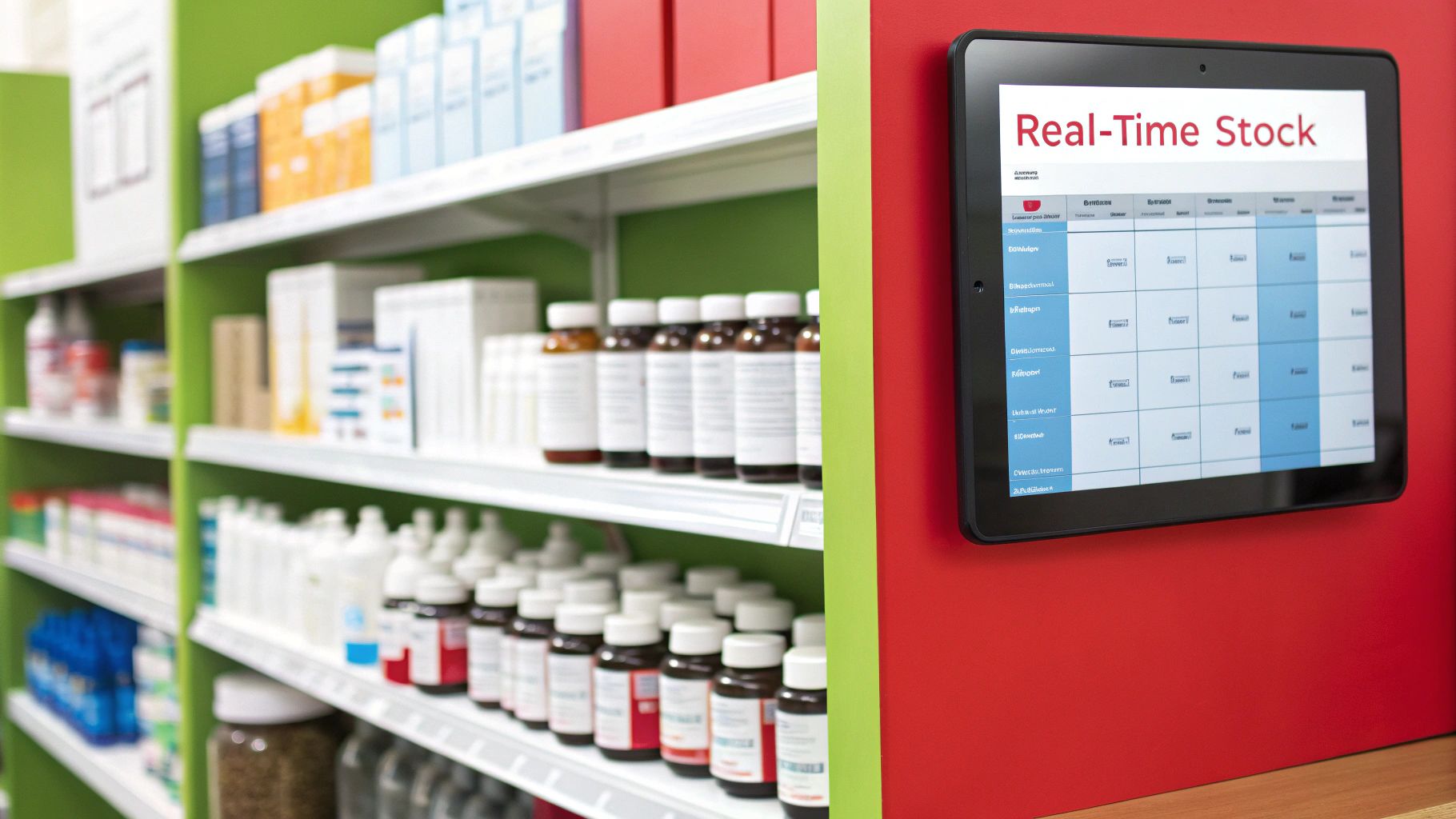
At its heart, running a pharmacy is a constant balancing act between patient demand and the realities of the supply chain. Get it wrong, and you’re in trouble. Without a robust system, you risk running out of critical medications or, just as bad, having costly drugs expire on the shelf. This is where dedicated software stops being a "nice-to-have" and becomes a necessity.
This shift is part of a much bigger picture of automating healthcare processes to deliver better, more efficient care. Instead of relying on manual counts and sheer guesswork, the software gives you a live, data-backed view of every single item in your stock.
The High Cost of Manual Management
Sticking to old-school, manual methods isn't just inefficient—it’s a direct threat to your bottom line and the trust you’ve built with patients. Manual tracking is practically an invitation for human error, and the consequences can be severe.
- Financial Drain: A poorly managed inventory bleeds money through expired drugs and ties up precious capital in stock you don’t need.
- Operational Drag: Your highly skilled pharmacists and technicians end up spending hours on tedious administrative work instead of focusing on what they do best: patient care. You can see how technology solves similar issues and drives innovation in retail stores in our related guide.
- Compliance Risks: Inaccurate records are a huge red flag. They can lead to serious regulatory headaches and, even worse, jeopardize patient safety.
The move to specialized software isn't just a trend. It's a strategic imperative, driven by very real financial and operational pressures. It’s about transforming your inventory from a liability into a tightly controlled asset.
A Market Poised for Growth
The growing dependency on these systems is plain to see in the market numbers. The global market for pharmacy inventory software hit USD 6.63 billion in 2024 and is expected to climb to around USD 14.23 billion by 2034. What’s fueling this? A combination of rising prescription volumes and increasingly strict regulations.
You can dive deeper into the market drivers and get more insights over at Precedence Research.
A Look at Core Pharmacy Inventory Software Features

To really get why pharmacy inventory management software is such a game-changer, you have to look under the hood. The features aren't just bells and whistles; they’re the engine that turns a chaotic stockroom into a smooth, responsive operation. Each one is designed to solve a specific, nagging problem that pharmacists have wrestled with for years.
Think of these features as a specialized crew, where every member has a critical job. Together, they make sure the right medication is in the right place, at the right time, and for the right cost. This is how you shift from constantly putting out fires to making smart, proactive decisions based on real data.
Real-Time Inventory Tracking
The absolute bedrock of any modern system is real-time tracking. It’s like having a GPS tag on every single bottle, box, and vial in your pharmacy. Using barcodes or RFID tags, the software logs every item the moment it arrives, when it hits the shelf, and when it’s handed to a patient.
What you get is a live, digital map of your entire inventory. No more guessing games or rummaging in the back room. You know exactly what you have and precisely where it is, down to the last pill. This pinpoint accuracy is also a key part of advanced shelf tracking systems that give you an incredible level of control.
Automated Ordering and Replenishment
Next up is automated ordering, which is like having a data scientist on your team. The software doesn't just count what you have—it analyzes dispensing patterns, historical sales, and even seasonal demand to predict what you'll need next. It learns the unique rhythm of your pharmacy.
Based on that insight, the system automatically generates purchase orders when stock drops to a certain level. This smart forecasting single-handedly prevents the two biggest inventory headaches: running out of a crucial medication (stockouts) and tying up money in products that just sit there (overstock).
By moving from manual guesswork to data-driven predictions, automated ordering transforms inventory management. It stops being a constant chore and becomes a strategic advantage, ensuring your supply always meets patient demand.
Expiration Date Management
Finally, expiration date management acts as your financial and safety watchdog. Trying to manually track expiry dates across thousands of products is a recipe for disaster. The software takes over, automatically flagging medications that are getting close to their expiration date.
This gives pharmacists a heads-up to dispense older stock first or return items for credit before they become a complete loss. This feature alone prevents a ton of financial waste and—more importantly—protects patients by making sure expired drugs never make it into their hands. The impact is huge, with data showing automated systems can cut logistics costs by 10-15% and slash slow-moving inventory by 20-30%. You can dig into more of these stats from Coherent Market Insights.
Manual vs Automated Pharmacy Inventory Management
Switching from pen-and-paper or spreadsheet-based inventory to a dedicated software solution can feel like a big leap. But when you break it down task-by-task, the difference is night and day. The old way is filled with manual labor, guesswork, and costly errors, while the modern, automated approach brings efficiency and precision.
Here’s a direct comparison of how common pharmacy tasks are handled in each system:
| Task | Manual Process (The Old Way) | Automated Software (The Modern Way) |
|---|---|---|
| Stock Counting | Physically counting every item by hand, often after hours. | Barcode or RFID scans update counts instantly and continuously. |
| Ordering | Guessing future needs based on past experience and memory. | Data analysis predicts demand and automatically creates purchase orders. |
| Receiving Stock | Manually checking deliveries against paper invoices. | Scans instantly verify shipments and update inventory levels. |
| Expiration Tracking | Spot-checking dates on shelves, hoping nothing gets missed. | System automatically flags items approaching their expiration date. |
| Reporting | Tediously compiling data in spreadsheets for a fuzzy overview. | Generates detailed, real-time reports with a few clicks. |
It's clear that automation doesn't just make things faster; it makes them smarter. By taking over the repetitive, error-prone tasks, software frees up pharmacists and technicians to focus on what truly matters: patient care.
The Real-World Benefits of Automated Inventory Control

Features are just the mechanics of a system. The real story is about the tangible outcomes they create. For any pharmacy, bringing in automated inventory control isn't really about the tech itself—it's about building a stronger business, empowering your staff, and better serving the community.
The benefits ripple through every corner of the operation, from the back office to the front counter.
Think of it like this: you can spend all your time plugging leaks in a boat, or you can have a vessel that just sails smoothly. One is reactive and exhausting; the other is proactive and strategic. That’s what pharmacy inventory management software delivers—a smarter way to run your pharmacy.
Fortifying Your Financial Health
The most immediate and obvious impact is on your bottom line. When your inventory is optimized, you directly reduce carrying costs. This frees up capital that would otherwise be sitting on shelves as overstocked medications.
More importantly, automated expiry tracking turns a major source of financial loss into a completely manageable process.
Instead of finding expired drugs during a surprise manual count, the system flags them well in advance. This gives your team a heads-up to prioritize dispensing older stock or process returns for credit, preventing thousands of dollars from ending up in the trash. For most pharmacies, this benefit alone delivers a clear and rapid return on investment.
Driving Operational Excellence
A pharmacy's most valuable asset isn't its stock; it's the expertise of its pharmacists. When these highly trained professionals are stuck doing manual counts, they aren't practicing at the top of their license. Automation frees them from those tedious, time-draining tasks.
This simple shift allows pharmacists to focus on high-value activities that truly matter, like patient consultations, medication therapy management, and other clinical services. It’s not just a boost for staff morale and a way to reduce burnout; it also opens up new revenue streams for the pharmacy. By elevating the role of your team, you can significantly improve operational efficiency across the board.
By automating routine inventory tasks, pharmacies empower their clinical staff to work more closely with patients, enhancing care quality and solidifying the pharmacy's role as a vital healthcare hub.
Enhancing Patient Safety
At the end of the day, the most critical benefit is protecting your patients. Inaccurate inventory data is a direct risk. It could lead to a patient being told a life-saving drug is out of stock when it’s simply misplaced on a shelf.
Accurate, real-time data ensures that what your system shows is what's actually in the pharmacy.
This level of accuracy is a cornerstone of a market expected to grow at a CAGR of around 7.9% through 2030, a surge driven by the urgent need to reduce medication errors. Top-tier healthcare systems are already on board, with some dedicating 60% to 70% of their pharmacy budget to inventory management because they understand how critical it is.
How To Choose The Right Software For Your Pharmacy

Choosing the right pharmacy inventory management software is a huge decision, one that will echo through your daily operations for years to come. This isn't just about buying a new tool; it's about finding a reliable partner that supports your pharmacy's long-term health. The best place to start isn't with a flashy software demo, but with an honest look at your own pharmacy.
Before you even think about talking to a vendor, you need to do a deep dive into your current inventory processes. Where do things get stuck? Is your team constantly drowning in manual counts? How much money are you bleeding from expired medications? Nailing down these specific pain points gives you a crystal-clear list of problems that the new software absolutely must solve.
Establish Your Core Decision Criteria
Once you know what’s broken, you can build a solid framework for judging potential solutions. Let's be clear: not all software is created equal. The perfect system for a massive hospital pharmacy will likely be a terrible fit for a small, independent community shop. Your goal is to zero in on a handful of non-negotiable criteria that match your real-world needs.
Key factors you can’t afford to ignore include:
- Seamless Integration: The software has to play nicely with your existing Pharmacy Management System (PMS) and any Electronic Health Records (EHR) you rely on. A system that can't talk to your other platforms is just going to create new headaches.
- Intuitive User Interface (UI): Your staff is busy. They need a system they can pick up fast, without a steep learning curve. A clunky, confusing interface leads to frustration, mistakes, and a much slower return on your investment. Look for clean, logical designs that feel natural.
- Scalability for Growth: The software you choose today has to be ready for where your pharmacy is headed tomorrow. Make sure the platform can handle more prescriptions, new locations, or expanded services without forcing you to start all over again.
Choosing the right software is a strategic partnership. The technology is just one piece of the puzzle; equally important is the quality of the vendor's training, implementation support, and ongoing customer service.
Comparing Your Options Systematically
With your must-haves list in hand, it’s time to start sizing up the vendors. You have to look past the shiny marketing brochures and get into the nitty-gritty details. When you’re checking out different options, it’s a good idea to see what’s out there, including advanced business inventory management solutions like Fishbowl, to get a feel for the full range of possibilities.
A simple checklist can be your best friend here, letting you compare vendors side-by-side. It keeps you organized and ensures your final decision is based on hard facts, not just a slick presentation. The right software is a game-changer, especially when it works in concert with other modern tools like the digital label software used for instant price and information updates.
Here’s a straightforward checklist you can adapt to weigh your options. It will help you methodically evaluate how different software vendors stack up against your pharmacy's specific needs.
Software Selection Checklist for Your Pharmacy
| Evaluation Criteria | Vendor A | Vendor B | Vendor C |
|---|---|---|---|
| PMS/EHR Integration | |||
| User-Friendliness | |||
| Automated Ordering | |||
| Expiration Tracking | |||
| Reporting & Analytics | |||
| Training & Support | |||
| Scalability | |||
| Total Cost of Ownership |
Using a structured approach like this turns a potentially overwhelming decision into a manageable process. It helps you focus on what truly matters for your pharmacy, ensuring you invest in a solution that will pay dividends for years to come.
The Future of Pharmacy Inventory Is AI and Automation
We're seeing a fundamental shift in how pharmacies handle their inventory. It’s no longer about simply reacting to what’s on the shelf; it's about getting ahead of the curve. This is where artificial intelligence and automation are changing the game. The next wave of pharmacy inventory management software isn’t just for tracking and reordering—it's evolving into an intelligent system that predicts what you'll need before you even know you need it.
This shift follows a larger trend of automation in the retail industry, where making decisions based on data is the new normal. For pharmacies, this means using machine learning to forecast demand with stunning accuracy. These algorithms look way beyond just past sales, crunching numbers on local health trends, seasonal flu patterns, and even public health alerts to figure out which medications will be in high demand.
The Rise of the Smart Pharmacy
Picture a pharmacy where the inventory practically manages itself. That’s the idea behind the "smart pharmacy." Here, tiny Internet of Things (IoT) sensors are the unsung heroes. They constantly monitor the storage conditions for sensitive medications like vaccines, sending an immediate alert if the temperature strays even slightly from the safe zone.
This isn't just about ticking a box for compliance. This proactive watch ensures every single drug is effective and safe, protecting both patient health and the pharmacy's bottom line. It’s a complete pivot from a "just-in-case" stockroom to a "just-in-time" predictive model where problems are solved long before they can affect a patient.
Investing in modern pharmacy software with these kinds of capabilities is more than an efficiency play. It's about future-proofing your entire operation against supply chain hiccups and the ever-changing demands of patient care.
AI as the New Standard
The real driver behind this transformation is artificial intelligence. AI brings some serious horsepower to the table, with predictive demand forecasting, automated reordering triggered by smart algorithms, and sophisticated expiry alerts. These features drastically cut down on medication errors and make day-to-day operations much more accurate—a huge win for patient safety. If you want to dive deeper into how AI is shaking up the market, you can check out the latest market research.
This move toward intelligent automation isn’t some far-off concept; it’s quickly becoming the benchmark for what a well-run pharmacy looks like. By embracing these tools, pharmacies can not only sharpen their competitive edge but also solidify their role as essential pillars of community health.
Making It Stick: Best Practices for Lasting Success
A powerful tool is only as good as the person using it. Bringing new pharmacy inventory management software into your workflow isn’t like flipping a switch. It takes a smart strategy to make the transition smooth and set yourself up for long-term wins. A solid implementation plan is what separates a frustrating tech headache from a game-changing investment.
The real work actually starts before you even go live. First things first: clean up your existing inventory data. Trying to migrate messy or outdated information into a shiny new system is like building a house on a shaky foundation—it’s a recipe for disaster.
Once your data is clean, map out a phased rollout. Instead of a jarring, all-at-once change that throws everyone for a loop, introduce the software in stages. This approach dials down the operational chaos and gives your team a chance to get comfortable with the new way of doing things.
Get Your Team on Board with Great Training
You can have the best software in the world, but if your team doesn't know how to use it, it’s worthless. Comprehensive training is non-negotiable. And this needs to be more than just pointing at buttons on a screen. Real adoption happens when your staff understands why you’re making the change and can see for themselves how it makes their jobs easier.
Focus on practical, hands-on sessions that cover real-world pharmacy scenarios. When your team feels confident with the system, they become its biggest advocates, making sure it gets used to its full potential from day one.
"A successful rollout isn't a one-time event. It's the start of a constant cycle of improvement. The goal is to weave the software so deeply into your daily operations that it just becomes the natural, data-driven way you work."
Keep the Momentum Going for Continuous Improvement
After you're up and running, the focus shifts to keeping your data accurate and using the system's analytical muscle. Building good habits around the software is what will deliver real, long-term value from your investment. These routines ensure the system stays sharp.
To lock in that success, work these key practices into your weekly routine:
- Run Regular Cycle Counts: Ditch the painful annual inventory count. Instead, do smaller, more frequent checks on specific sections. This keeps your numbers laser-accurate without shutting everything down.
- Actually Use the Analytics Reports: Make a habit of looking at reports on stock turnover, slow-moving products, and purchasing trends. This is where you'll spot huge opportunities to optimize and save money.
- Create Clear Workflows: Write down exactly how you want things done, like receiving new stock or handling returns. Documented procedures create consistency and make sure everyone is on the same page.
By sticking to these practices, you'll do more than just install a new tool. You'll make it a core part of your pharmacy's engine for continuous improvement.
Got Questions? We've Got Answers
Stepping into the world of pharmacy inventory management software naturally brings up a few questions. It's a big decision, and you need to know what you're getting into. Here are the straight answers to the things we hear most often from pharmacy owners just like you.
How Long Does This Whole Implementation Thing Take?
You're busy, I get it. The good news is, a standard rollout for a single pharmacy usually wraps up in about four to eight weeks. That timeframe covers everything from getting your data moved over from the old system, setting up the hardware, and most importantly, training your staff so they feel confident from day one.
A lot of pharmacies find a phased approach works best. Instead of flipping a switch on everything at once, you introduce one piece of the software at a time. This keeps the daily workflow running smoothly and lets your team get comfortable without feeling overwhelmed.
Will This Software Actually Talk to My Existing Pharmacy System?
Absolutely—that’s one of the most critical features. Modern inventory platforms are built to play nicely with the systems you already rely on, like your Pharmacy Management System (PMS) and Electronic Health Records (EHR).
The goal is to create a seamless connection so your dispensing data and inventory counts are always perfectly in sync. This kills off the need for double-entry and slashes the risk of costly mistakes. Just be sure to double-check that the software you're eyeing is fully compatible with your specific setup before you sign on the dotted line.
A new software system should feel like a natural part of your workflow, not another hurdle to jump. Always put systems with proven, solid integrations at the top of your list. It's the only way to get a single, unified view of your operations.
What's the Real Cost of Pharmacy Inventory Software?
The price tag can vary quite a bit, depending on the size of your pharmacy and how many bells and whistles you need. Most companies now use a subscription model, which means you'll typically pay a monthly fee per location or even per user.
This fee almost always bundles in the software license, all the ongoing tech support you'll need, and regular updates to keep things running sharp. And while it's definitely an investment, the money you save by cutting down on medication waste and making your team more efficient usually delivers a pretty fantastic return.
Ready to bring your pharmacy's operations into the modern age with digital precision? ESLtags offers cutting-edge electronic shelf labels that sync directly with your inventory system for instant, error-free updates. See how our solutions can save you time and money at https://www.electronicshelftags.com.


Leave a Reply
Your email is safe with us.