

Price labels on shelves are one of those things you don't think much about until you realize how much they've changed. They’ve gone from simple paper tags to tiny, sophisticated digital screens. The core difference? Traditional labels are static and need to be changed by hand, one by one. Electronic shelf labels (ESLs), on the other hand, can be updated instantly from a central computer, which saves an incredible amount of time and cuts down on errors.
This guide is all about that evolution. We'll break down everything to help you figure out which system makes the most sense for your store.
Why Shelf Pricing Is a Retail Cornerstone
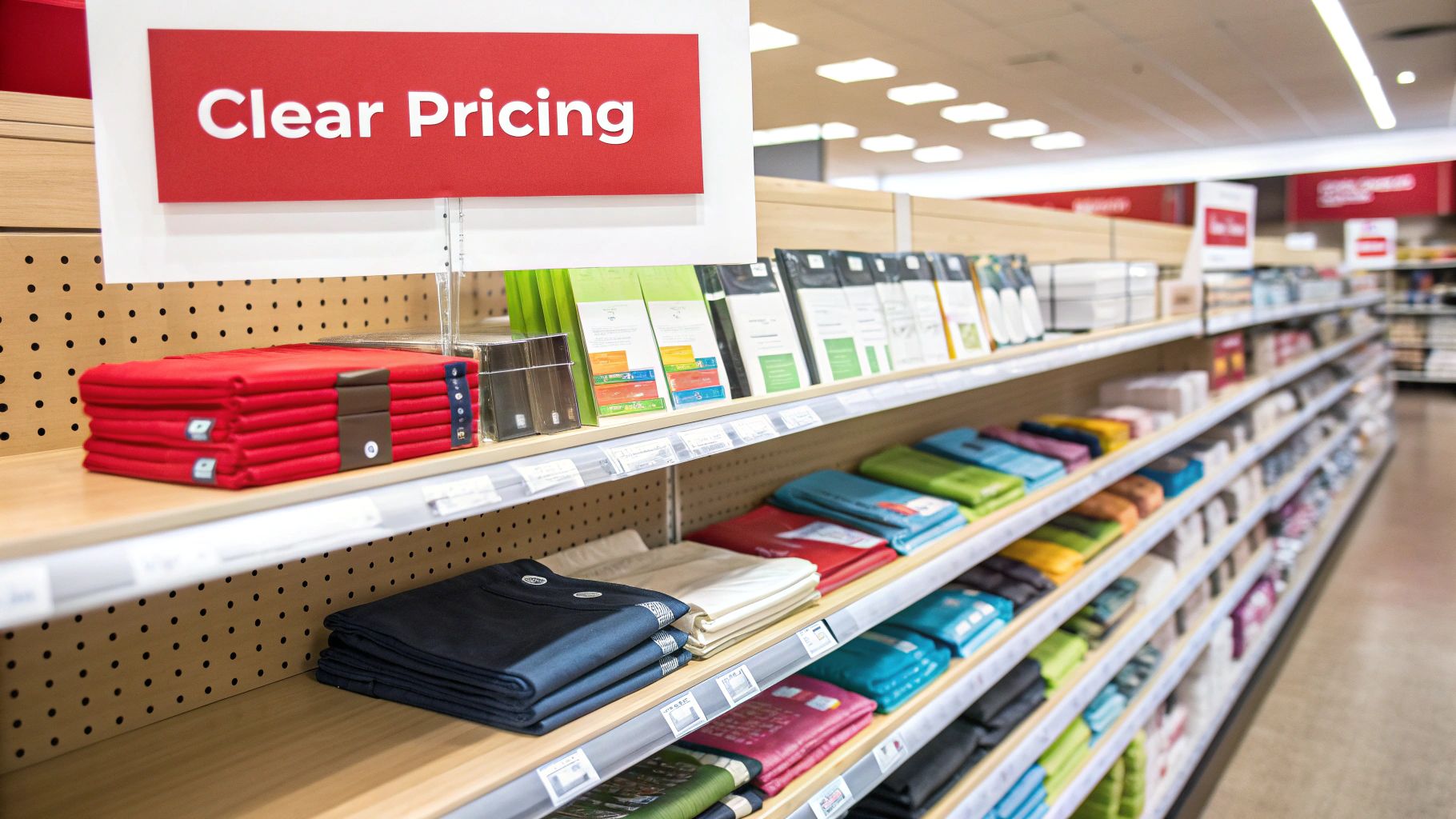
When it comes down to it, a price label is the final handshake between you and a customer right before they decide to buy. It’s what communicates value, builds trust, and keeps the checkout line moving smoothly. For decades, that job belonged to the humble paper tag, printed out and painstakingly placed on the shelf by an employee.
But retail today moves a lot faster. Switching from paper to electronic labels is like ditching a paper road map for a live GPS. The map will get you where you’re going, sure, but it can't react to traffic jams, road closures, or a last-minute change of plans. A GPS, however, recalibrates on the fly, always showing you the best way forward.
Electronic shelf labels are that GPS for your store. They give retailers the power to adjust pricing instantly across thousands of products, react to a competitor’s sale, or launch a flash promotion with just a few clicks.
This leap in technology is completely changing how stores operate. It’s no longer just about showing a price; it’s about creating a more agile, efficient, and data-driven shopping environment. We'll walk you through everything you need to know about price labels for shelves, from the basics to the nitty-gritty of implementation.
What This Guide Covers
We’re going to dig into all the critical pieces of modern shelf labeling so you can get a crystal-clear picture of your options. Here’s a quick look at what’s ahead:
- Detailed Comparison: A deep dive into the pros and cons of old-school paper labels versus their new digital counterparts.
- Key Benefits: How an upgrade can make your operations smoother, guarantee pricing accuracy, and give your customers a better experience.
- Implementation Steps: A practical, step-by-step roadmap for choosing and rolling out a new labeling system in your store.
- Financial Considerations: A no-nonsense breakdown of the costs involved and how to figure out the return on your investment.
Paper Labels vs. Digital Displays: A Tale of Two Shelves
When you're deciding on shelf price labels, it feels like a classic showdown: the upfront, easy cost versus long-term, smart value. Traditional paper labels are what we all know. They're simple, cheap to get started with, and don't require much more than a printer and a roll of sticky paper. For a retailer just opening their doors, that low barrier to entry is pretty appealing.
But that initial simplicity has a hidden, and often hefty, price tag down the road. Every single time a price changes, a promotion kicks off, or a product gets updated, an employee has to stop what they're doing. They print the new label, trek out to the aisle, find the right spot, and make the swap. This isn't just a time-sink; it's a breeding ground for human error, creating those frustrating price mismatches that chip away at customer trust and your bottom line.
The True Cost of Manual Updates
Picture this: you're launching a big weekend flash sale on 500 different products. With paper labels, that simple idea explodes into a massive logistical headache. You might need a team of employees spending hours—maybe even an entire shift—just printing and swapping out all those little tags.
And what happens Monday morning? They have to do it all over again, switching everything back to the original price. This repetitive cycle burns through valuable staff hours that could be spent helping customers, restocking shelves, or actually improving the store.
This is where Electronic Shelf Labels (ESLs) completely change the game.
With a digital system, that same 500-product flash sale is launched with a few clicks from a single computer. Prices update instantly and accurately across the entire store. No printing, no paper waste, and zero manual labor needed on the sales floor.
This kind of agility is a massive advantage. It opens the door to dynamic pricing, letting you react to a competitor's sale in real-time and guaranteeing 100% price accuracy between the shelf and the checkout. To get a better sense of how it all works, you can learn more about the technology behind electronic shelf labelling systems.
Weighing Investment Against Return
Okay, so what's the catch? The main hurdle for most retailers is the initial investment. ESLs aren't just paper; they're hardware, software, and the network to run it all. But looking at it as just a one-time expense is missing the bigger picture—the long-term return on that investment (ROI).
The payoff goes way beyond just saving on labor. Think about it:
- No More Errors: You completely eliminate lost revenue from underpriced items or awkward customer disputes over incorrect tags.
- Less Waste: Digital tags mean you can say goodbye to the constant cost of paper, ink, and printer headaches, not to mention the environmental impact.
- Smarter Staffing: Your team is freed from the mind-numbing task of changing price tags, letting them focus on what they do best: customer service and merchandising.
This shift from paper to digital isn't happening in a vacuum. It lines up perfectly with the broader future trends in business automation, where smarter, more efficient operations are becoming the standard. The numbers back it up, too. The global electronic shelf label market was valued at USD 1.85 billion in 2024 and is expected to rocket to USD 7.54 billion by 2033. That’s a powerful signal of where retail is headed.
Key Benefits of Upgrading Your Shelf Labels

Stepping up from traditional paper tags isn't just a minor tweak—it's a move that directly boosts your store's efficiency, accuracy, and the overall happiness of your customers. Modernizing your price labels for shelves goes far beyond a simple facelift; it’s a strategic decision that strengthens your entire retail operation from the ground up.
The first thing you'll notice is the incredible jump in efficiency. Just think about the sheer amount of time your team sinks into printing, cutting, and physically swapping out hundreds, if not thousands, of paper labels. Electronic Shelf Labels (ESLs) give you all that time back, letting your staff focus on what truly matters—helping customers and creating amazing in-store displays.
Boost Your Operational Efficiency
Forget the slow, mistake-prone process of manually changing prices. With a digital system, a price update is instant. A store-wide sale that used to burn an entire day can now be launched in minutes, right from a central dashboard.
This shift brings a few immediate wins:
- Slashed Labor Costs: You'll see a dramatic drop in the hours needed for routine price changes and audits.
- Lightning-Fast Rollouts: Deploy promotions, flash sales, and competitor price matches in the blink of an eye.
- Smarter Staffing: Reassign your team from tedious tasks to customer-facing roles where they can make a real difference.
Achieve Perfect Pricing Accuracy
Pricing mistakes are one of those silent killers of profit and a huge source of frustration for shoppers. When the price on the shelf doesn't match the price at the register, you risk losing sales and eroding customer trust for good. ESLs make that problem disappear.
By syncing directly with your Point of Sale (POS) system, electronic labels guarantee 100% price accuracy between the shelf and the checkout. No more manual typos, no more awkward disputes, and no more lost revenue from pricing slips.
This level of accuracy also opens the door to dynamic pricing. You can adjust prices on the fly based on demand, stock levels, or what your competition is doing. Digging into the full benefits of electronic shelf labels shows just how much of a competitive advantage this agility can provide.
Elevate the Customer Experience
Today's shelf labels are so much more than just a price tag. They act as a mini information hub right where your customer is making a decision. The clear, easy-to-read digital screens build confidence and deliver key details at a glance.
Many ESLs can show a lot more than just the cost:
- Promotional Callouts: Instantly flag deals like "Buy One, Get One" or "30% Off" directly on the label.
- Helpful Product Details: Display unit pricing, current stock levels, or even where the product came from.
- Interactive QR Codes: Give shoppers a direct link to online reviews, how-to videos, or in-depth product specs.
All of this works together to create a richer in-store experience, arming customers with the information they need to feel great about their purchases right at the point of decision.
How to Choose the Right Labeling System
Picking the right price labels for shelves isn't just a minor decision—it’s like choosing a new central nervous system for your entire store. Get it right, and everything flows seamlessly. Get it wrong, and you're in for a world of headaches.
Before you even think about brands or models, the first step is to look inward. Seriously. The needs of a small, local boutique with mostly static pricing are worlds apart from a sprawling supermarket that changes thousands of prices every single week.
The key is to match the solution to your business's unique rhythm. A large-format store with high product turnover will see a much faster return on a fully automated system. A smaller shop, on the other hand, might find that simplicity and a lower upfront investment make more sense.
Evaluating Key Factors for Your Store
To make a smart choice, you need to get brutally honest about a few core areas of your operation. This isn't just about the tech; it's about how that tech will integrate into your daily workflow and existing infrastructure. A great system on paper is useless if it doesn't play well with what you already have.
Here’s a practical checklist to guide your thinking:
- POS and Software Integration: How smoothly will this new system talk to your Point of Sale (POS) and inventory management software? This connection has to be flawless. It’s absolutely non-negotiable for keeping your data accurate and your operations efficient.
- Budget and Long-Term ROI: Don't just get fixated on the initial price tag for the hardware. You need to think bigger. Factor in recurring software licenses, potential maintenance costs, and—most importantly—the long-term savings you'll gain from slashing labor hours and eliminating pricing errors for good.
- Store Environment: Take a walk through your aisles. Are your shelves pretty standard, or do you have a mix of unique fixtures like refrigerated cases, pegboards, or curved displays? Make sure your vendor can provide durable holders and attachments that actually fit your specific setup.
- Technical Support: Let's be real—digital labeling systems are sophisticated. When things go wrong (and they sometimes do), who are you going to call? It’s often worth exploring options like managed IT services for retail technology to have experts on standby.
Understanding the Technology
It’s easy to think all electronic labels are the same, but that couldn't be further from the truth. The display technology itself is a huge deal, as it directly impacts everything from how good the labels look to how long their batteries last. The clear winner in the retail space today is the e-paper display.
E-paper is the same magic you see in e-readers. It’s incredibly energy-efficient because it only sips power when the display is actively changing. Once the price and product info are set, the screen holds that image perfectly without using any battery at all. This is why some labels can last 5-10 years on a single coin battery.
This incredible efficiency is fueling a massive shift in retail. A 2024 market analysis valued the global electronic shelf label market at a staggering USD 2.34 billion, with projections showing it will hit USD 4.18 billion by 2029. The workhorse behind this growth is the segmented e-paper display, which strikes the perfect balance between crystal-clear readability and insane battery life.
But modern systems do so much more than just show a price. Many of today’s ESLs can be paired with advanced shelf tracking systems. This gives you real-time data on stock levels and even where products are located, helping you optimize your store's performance in ways that were impossible with paper. Choosing the right tech today is really about future-proofing your entire operation for tomorrow.
A Guide to Implementing Your New Price Labels
Making the jump to new price labels, especially electronic ones, can feel like a huge undertaking. But it doesn't have to be a headache. The secret is to treat it like any major project: break it down into smaller, manageable steps instead of trying to tackle everything at once.
A smooth transition always starts with a solid plan. This is where you map out your goals, figure out a realistic budget, and do your homework on different vendors. Don't just look at the price of the hardware; you need to think about software integration, what their long-term support looks like, and how durable the labels and their holders really are.
Start with a Pilot Program
Before you go all-in on a store-wide rollout, it’s a smart move to run a pilot program in just one department or even a single aisle. Think of it as a dress rehearsal. This gives you a controlled environment to spot and iron out any technical glitches or workflow snags on a small scale, stopping them from becoming massive problems down the line.
A pilot program is your chance to get answers to some critical questions:
- System Integration: Is the new system talking to your existing POS and inventory software without any hiccups?
- Staff Training: What are the most common questions your team has? Where are they getting stuck during day-to-day use?
- Hardware Performance: How well do the labels actually perform in the real world? Do they hold up in busy aisles or in tricky spots like the refrigerated section?
Plan for a Smooth Rollout
Once you've seen success with the pilot, you're ready to plan the full-scale installation. To keep disruptions to a minimum for both shoppers and your staff, try to schedule the physical setup during off-hours—either overnight or on a day you're closed. This keeps the aisles clear and lets your installation team work their magic without interruption.
The goal is a seamless transition, not a chaotic overhaul. A well-planned installation means that when you open your doors, the new system is up and running, completely accurate, and ready to make the shopping experience better.
Proper staff training is absolutely non-negotiable. Your team needs to feel confident with the new system from the moment it goes live. Give them clear, hands-on training that covers the basics, like updating a price, all the way to troubleshooting common issues. For a deeper understanding, our guide on how electronic shelf price tags work can give your team the foundational knowledge they need. When you empower your people, the technology becomes more than just a price display—it becomes a powerful tool for running your store.
Calculating the ROI of Your Investment
Let's be honest: switching from paper to electronic price labels for shelves requires a real investment. You're looking at new hardware, software, and getting it all installed. But if you only see it as an expense, you're missing the bigger picture.
The smart move is to calculate the return on that investment (ROI). It's not just about what you spend, but what you gain back over time.
We're not just talking about saving a few bucks on paper and ink, either. The real win comes from freeing up your employees. Think about the hundreds of hours they spend printing, cutting, and swapping out tiny bits of paper. That time can be poured back into helping customers, improving displays, and other activities that actually make you money. It's a fundamental shift in how your store operates.
Quantifying Your Savings
To make a strong business case, you need to put some hard numbers behind the benefits. The best way to do this is to break down your potential savings into clear, measurable categories. This approach turns abstract ideas into a solid financial projection.
Here are the key areas to focus on when calculating your ROI:
- Labor Savings: How many hours do your employees currently spend on pricing tasks each week? Multiply those hours by their wage, and you'll see exactly what manual labeling is costing you.
- Material Cost Elimination: Tally up what you spend in a year on label paper, printer ink, and printer maintenance. With electronic shelf labels, these costs vanish completely.
- Pricing Error Reduction: Think about the money you lose from accidental underpricing or the goodwill lost from customer disputes over wrong prices. Even a tiny percentage of errors can cost you thousands annually.
To get these forecasts right, you need a solid grasp of your entire pricing structure. That means understanding core concepts like calculating wholesale prices so your profit margins stay healthy, even when you're making instant price changes.
When you quantify these savings and stack them up against the upfront cost, the math often tells a surprising story. You'll likely find the system pays for itself much faster than you imagined, turning what felt like a cost into a powerful strategic asset.
And don't forget the customer experience. Modern digital labels make shopping clearer and more reliable, which translates to happier shoppers and more sales over time. To see how this works in a real-world setting, check out how digital signage in grocery stores is already changing the game right at the shelf edge.
Of course. Here's that section rewritten to sound more natural and human, as if from an experienced retail expert.
Your Top Questions About Shelf Price Labels, Answered
Even when you see the potential, it's natural to have questions about how these systems work day-to-day. After helping countless retailers make the switch, I've heard them all. Let's tackle the big ones right now.
It makes sense that one of the first things people wonder about is durability and upkeep. You're moving from a simple piece of paper to a piece of technology, after all.
How Long Do the Batteries Last?
This is the most common question I get, and the answer usually surprises people: the batteries in electronic shelf labels (ESLs) last a remarkably long time, typically between 5 and 10 years.
How is that possible? They use the same e-paper technology you find in an e-reader. It's incredibly efficient because it only sips power when the price is actively changing. The moment the new price is displayed, the screen holds that image perfectly without using any electricity at all. While things like how often you run promotions can play a small role, you can realistically expect years of set-it-and-forget-it operation.
Can They Display More Than Just a Price?
Absolutely. In fact, if you're only thinking about price, you're missing half the magic. Modern ESLs are more like tiny information dashboards for your aisles.
Think of them less like a price tag and more like a direct line of communication to your customers and staff, right at the shelf. They close the gap between all the rich data in your system and the physical point where people make buying decisions.
They can show all sorts of helpful info, for instance:
- Promotional flags like "Sale" or "2-for-1"
- Unit pricing so shoppers can easily compare value
- Real-time stock levels or even alerts for your team
- QR codes that can link to product reviews, video tutorials, or your online store
Is Integration with a POS System Difficult?
This used to be a major headache, but not anymore. Reputable ESL providers build their systems with easy integration in mind. They provide powerful software and APIs that are designed to talk seamlessly with the most popular Point of Sale (POS) and inventory systems out there.
This connection is what delivers 100% pricing accuracy. When you update a price in your main system, it's instantly and automatically pushed to the right labels on the floor. It completely takes human error out of the equation.
Ready to see what a smarter, more efficient labeling system could do for your store? ESLtags offers cutting-edge electronic shelf label solutions built to improve accuracy and free up your team's time. Find out how our technology can transform your retail operations by visiting https://www.electronicshelftags.com today.


Leave a Reply
Your email is safe with us.