

For years, the gold standard for in-store advertising was a printed poster. But let’s be honest—in an age where we’re all glued to our screens, most shoppers walk right past them. Retail digital signage is the answer to that problem, swapping out static, forgettable paper for dynamic, engaging digital screens.
This isn't just about putting a TV on the wall. It’s technology that allows you to instantly update promotions, run eye-catching product videos, and create interactive moments that a paper poster could only dream of.
From Static Posters to Dynamic Experiences
Think of it like this: a printed sign is a silent, motionless picture. A digital sign is a blockbuster film, packed with color, movement, and a story. That’s the leap you’re making when you move to modern retail digital signage solutions.
The old way of doing things just can't keep up. A static poster can't tell a story, react to a customer walking by, or change its message when the lunch rush starts. It’s a one-size-fits-all approach, and in a world that craves personalization, that’s just not good enough anymore.
The Rise of Dynamic Content
Dynamic screens, on the other hand, turn your physical store into a smart, responsive environment. They give you the power to talk to your customers in real-time, making their entire shopping trip more interesting and helpful. This is about fundamentally changing how you engage with people inside your four walls.
It’s a complete shift in capability:
- Timeliness: You can launch a flash sale in seconds or start promoting umbrellas the moment it starts to rain.
- Engagement: Use touch screens to let shoppers dig into your product catalog or watch a how-to video.
- Personalization: Show different ads in the morning to catch the commuter crowd than you do in the evening for post-work shoppers.
This isn't just a gimmick; the numbers prove it works. The global market for retail digital signage was valued at USD 6.4 billion in 2024 and is expected to explode to USD 21.2 billion by 2034. Even better, retailers who made the switch saw an average sales lift of 32% in 2023, showing a direct hit to the bottom line.
Why This Matters for Modern Retail
This move toward digital isn’t a fleeting trend. It’s a smart response to what customers now expect. People want the same slick, digital convenience in-store that they get online. To really make this work, retailers need to get good at using powerful visual storytelling techniques.
By embracing these tools, savvy retailers aren’t just boosting sales—they’re building stronger, more memorable brand connections. This guide will walk you through the essential pieces of effective signage for retail, showing you how to turn every corner of your store into a chance to connect with your customers.
Understanding The Four Pillars Of Digital Signage
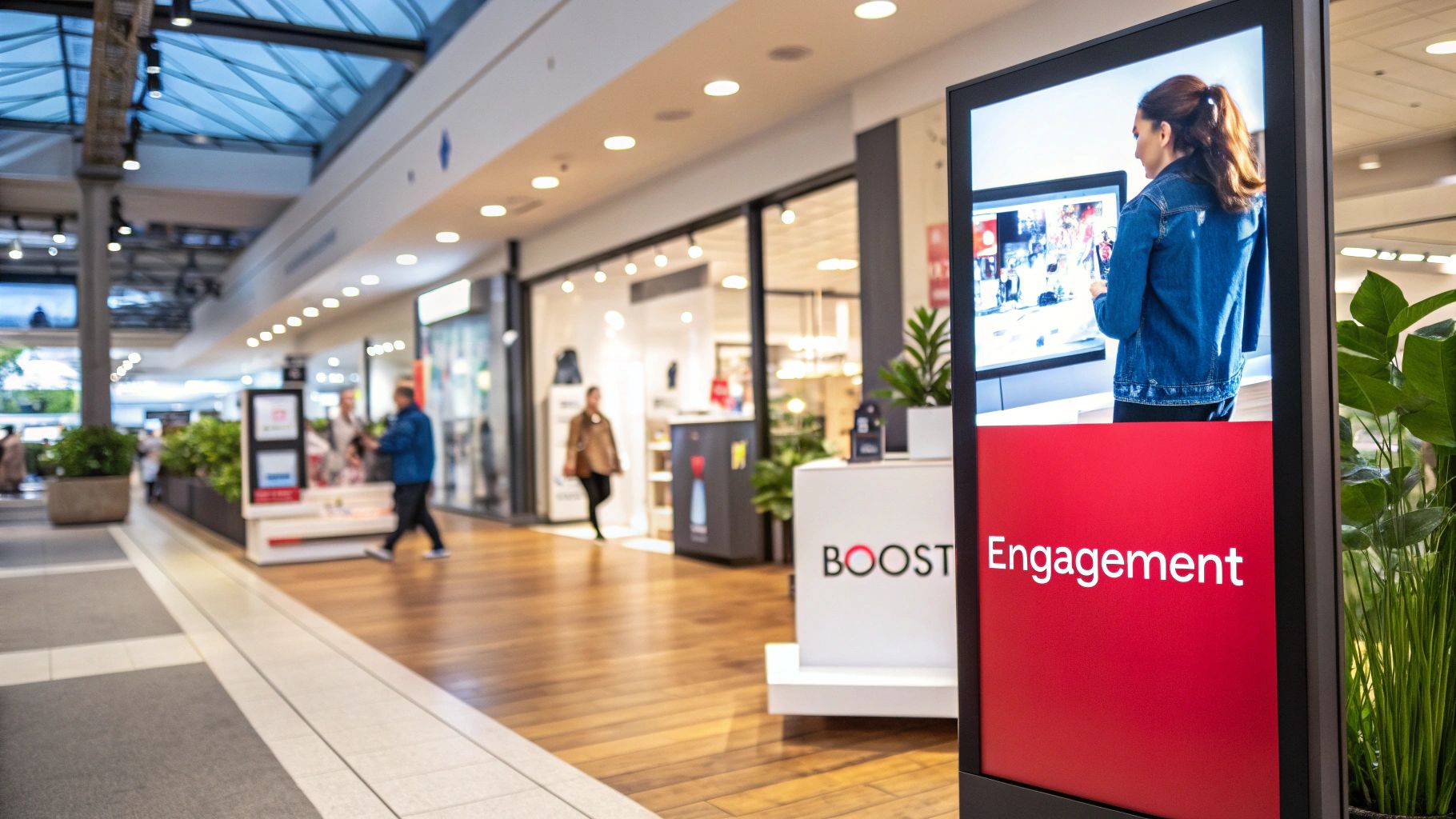
Getting into retail digital signage can feel overwhelming. But if you think of it like putting on a theatrical production, it all starts to click. For a show to be a hit, every single part has to work perfectly together. The same goes for your in-store displays.
This entire system rests on four essential pillars. When they all support each other, you create an experience that captivates customers and drives real results. Let’s pull back the curtain on each one.
The Four Pillars: A Quick Overview
To get started, it's helpful to see how all the pieces fit together. Each component has a distinct job, but none of them can succeed on their own. They form a complete ecosystem that brings your in-store marketing to life.
| Component | Role in the Ecosystem | Examples |
|---|---|---|
| Hardware | The physical stage where your content is displayed. These are the tangible assets customers see and interact with. | Commercial-grade screens, media players, wall mounts, interactive kiosks. |
| Software | The director calling the shots from behind the scenes. This is the central brain that controls what plays where and when. | Content Management System (CMS), analytics dashboards, remote device management tools. |
| Content | The actors who perform for the audience. This is the actual messaging that engages, informs, and persuades shoppers. | Videos, promotional graphics, interactive menus, social media feeds, live data. |
| Strategy | The script that guides the entire production. This is your game plan—the why behind every screen and every message. | Increasing foot traffic, upselling at checkout, reducing perceived wait times. |
This framework demystifies the whole process. Now, let’s dive deeper into what makes each pillar so crucial.
Pillar 1: Hardware — The Physical Stage
The hardware is the most obvious part of your setup. It's the stage itself—the screens, players, and mounts that bring your vision into the physical world. This isn't just about buying a TV and plugging it in; it's about building a reliable foundation.
Here’s what you’ll need:
- Commercial Displays: These are not your living room TVs. Commercial-grade screens are built to run for 16/7 or even 24/7, shine brighter to cut through harsh store lighting, and include warranties that cover business use. They are the absolute workhorses of any serious installation.
- Media Players: Think of these as the small but mighty computers that do the heavy lifting. They store and play your content, taking commands from your software to push the right visuals to the right screen at exactly the right time.
- Mounts and Enclosures: These are the unsung heroes. They securely fasten your displays to walls, ceilings, or kiosks, ensuring safety, perfect viewing angles, and a clean, professional look.
Trying to cut corners here with a consumer-grade TV might seem smart at first, but it will likely fail under the constant strain of a retail environment, costing you far more in the long run. For more specialized needs, like showing prices right on the shelf, options like e-ink signage are a fantastic low-power, high-clarity alternative. You can get a full rundown of e-ink signage to see how it fits into a broader display strategy.
Pillar 2: Software — The Director
If hardware is the stage, then your software is the director. Specifically, we're talking about the Content Management System (CMS). This is your command center, the central hub where you control everything your customers see. From here, you upload media, build playlists, and schedule content to run on one screen or a thousand.
A user-friendly CMS is absolutely non-negotiable. A clunky, confusing system will just gather dust because your team won't want to use it, defeating the whole purpose of having dynamic screens.
A great CMS lets you run your entire network of screens from a single dashboard. You can launch a nationwide promotion in minutes or even change the content in one store based on local weather—all without ever leaving your desk.
Pillar 3: Content — The Actors
Your content is the cast of actors on the stage—the videos, images, and messages that actually do the work of engaging shoppers. This is arguably the most important pillar of all. After all, the best hardware and software in the world are useless if your content is boring or out of date.
Great retail content should always be:
- Visually Striking: Use high-resolution images and smooth video to grab attention instantly.
- Short and Sweet: Shoppers are on the move. Your message needs to land in just a few seconds.
- Perfectly Timed: Make sure what's on-screen matches your current promotions, seasonal events, and what's actually in stock.
Without a steady flow of fresh, relevant content, your expensive digital signs will quickly fade into the background. This is where so many projects fall flat.
Pillar 4: Strategy — The Script
Finally, the strategy is the script that holds everything together. It's your master plan that answers what to show, where to show it, when to show it, and most importantly, why. Your strategy connects your screens to your business goals.
A solid strategy answers the tough questions. Are you trying to pull more people in off the street with a window display? Upsell at the checkout counter? Or just make the wait time feel shorter with entertaining clips? Each goal demands a different script, guiding your hardware placement, content, and scheduling to deliver real, measurable results.
Enhancing Every Step of the Customer Journey
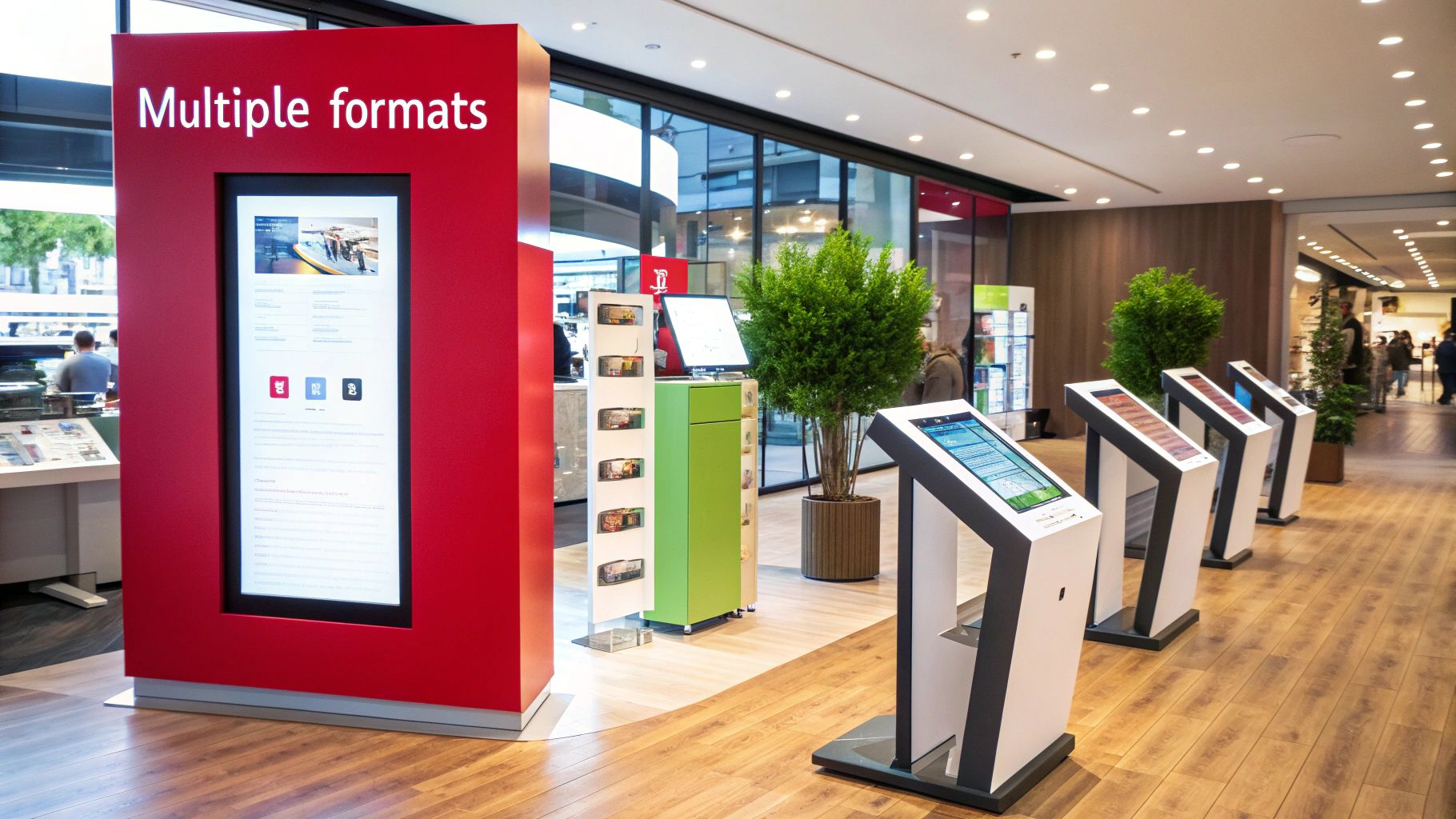
The theory is nice, but seeing retail digital signage solutions in the wild is where their true power clicks. Think about the entire shopping trip not as a bunch of separate tasks, but as a single, fluid experience. Digital displays are the friendly guides and storytellers that make it all happen.
This journey kicks off before a customer even walks through the door. By looking at real-world applications, we can see how this tech engages people at every touchpoint, from the sidewalk all the way to the checkout counter.
The First Impression: The Window Display
Your first point of contact is the storefront window—it’s your handshake with a potential customer. A static poster is easy to walk past and ignore, but a bright, dynamic screen showing off your latest collection? That’s a magnet. It turns a casual passerby into an interested viewer.
This first screen has one critical job: to break through the noise of a busy street and give someone a compelling reason to step inside. In fact, studies have shown that digital video displays can capture over 400% more views than old-school static signs.
This isn't just an ad; it's an invitation. You can use it to showcase:
- Flash Sales: Announce a limited-time deal to create a little FOMO (fear of missing out).
- New Arrivals: Display gorgeous, high-res visuals of products that just landed.
- Brand Storytelling: Play a short, compelling video that shares your brand’s mission or values.
This initial touchpoint sets the stage for the entire visit, signaling a modern and engaging experience awaits inside.
Guiding and Inspiring Inside the Store
Once they're in, the role of digital signage shifts from pure attraction to guidance and inspiration. The in-store environment is where you deepen that initial connection and start influencing purchase decisions. This is where interactive features really get to shine.
Imagine end-cap displays that run promotions for products on that very aisle, automatically updating based on inventory or even the time of day. That kind of targeted message is lightyears more effective than a generic, store-wide banner. On a grander scale, massive video walls can create an immersive atmosphere, turning a simple shopping trip into a memorable event.
Interactive kiosks are a total game-changer for customer convenience. If a shopper is looking for a specific item, they can use a touch-screen map for instant directions, check if it's in stock, or even pull up product reviews. It gets rid of frustration and puts them in control.
These tools don’t just sell—they serve. By offering up genuinely helpful information right when it's needed, you build trust and make the path to purchase a whole lot smoother. For retailers who want to take this even further, our guide on how to enhance customer experience is packed with more strategies for creating unforgettable in-store journeys.
The Final Touchpoint: Point of Sale
The journey wraps up at the checkout counter. This is your last chance to make a great impression and maybe even increase the final sale. Instead of a blank wall or a predictable candy rack, a point-of-sale (POS) screen can be a powerful tool.
These smaller, strategically placed displays are perfect for a few key things:
- Promoting Impulse Buys: Suggesting a matching accessory or a "don't forget this!" item that pairs perfectly with what they're already buying.
- Encouraging Loyalty Sign-Ups: Showing the instant perks of joining your rewards program with a simple, clear call to action.
- Reducing Perceived Wait Times: Flashing entertaining content, fun facts, or social media feeds can make any wait in line feel much shorter.
This final interaction ties the whole experience together. It reinforces the modern, helpful, and engaging vibe you’ve built from the moment they saw your window display, leaving them with a positive impression that brings them back.
How to Choose the Right Digital Signage Solution
Picking the right retail digital signage solution can feel like a huge decision, but it doesn't have to be overwhelming. If you break it down into a few key areas, you can move forward confidently and find a system that’s a perfect fit for your store. The real goal is to land on a solution that not only looks fantastic but also works like a dream for your team and your budget.
Let's walk through the critical factors to consider, from the layout of your physical space to your team's comfort level with technology. We'll explore the major choices you’ll face and arm you with the right questions to ask, so you can invest in a tool that actually drives growth, not creates headaches.
Start With Your Physical Environment and Goals
Before you even glance at a screen, take a good look at your own store. The perfect solution for a tiny, single-location boutique is going to be worlds apart from what a multi-state grocery chain needs. Your unique environment dictates the hardware, while your business goals will shape the content.
Think about these things first:
- Store Size and Layout: How many screens do you realistically need, and where will they live? Map out the high-traffic areas, check sightlines, and pinpoint potential interaction points like checkout counters or fitting rooms.
- Business Objectives: What's the job for each screen? Are you trying to pull people in off the street (window display), upsell specific products (end caps), or just make the shopping experience smoother (wayfinding)?
- Team Capacity: Who’s going to be in charge of updating the content? Your team's tech skills and available time will have a massive impact on the software you choose. An intuitive system is a must-have for it to be used consistently.
Answering these questions first gives you a powerful filter to apply when you start looking at vendors and their products.
Cloud-Based Versus On-Premise Solutions
One of the biggest technical forks in the road is choosing between a cloud-based and an on-premise solution. It’s a lot like the difference between streaming a movie on Netflix (cloud) versus playing a DVD you own (on-premise). Each has its own set of pros and cons depending on how you operate.
The market is definitely leaning one way. The global retail digital signage market, valued at USD 6.73 billion in 2024, is expected to soar to USD 12.3 billion by 2035. That growth is largely thanks to the flexibility of cloud-based systems that let retailers manage content across multiple locations in real-time. It also helps that 70% of consumers say digital screens directly influence what they buy.
This choice boils down to cost, maintenance, and accessibility. A cloud-based Content Management System (CMS) is hosted by the provider and accessed online, giving you remote management and automatic updates. An on-premise solution means you host the software on your own local servers—more control, but also way more responsibility.
For most retailers, especially those with more than one location, the cloud is a no-brainer.
Key Takeaway: The ability to update content across all your stores from a single, web-based dashboard is a massive advantage. It keeps your branding consistent and lets you roll out promotions in minutes, no IT staff required on-site.
To make this choice clearer, let's break down the core differences between hosting your signage software in the cloud versus on your own servers.
Cloud-Based vs On-Premise Signage Solutions
| Feature | Cloud-Based Solution | On-Premise Solution |
|---|---|---|
| Initial Cost | Lower (typically a subscription fee) | Higher (requires server hardware and software licenses) |
| Maintenance | Handled by the provider (updates, security) | Your responsibility (requires dedicated IT staff) |
| Accessibility | Manage from anywhere with an internet connection | Limited to your local network unless you set up remote access |
| Scalability | Easy to add more screens and locations | Can be complex and costly to expand |
| Data Control | Data is stored on the provider's servers | You have full control over your data and infrastructure |
Ultimately, the cloud offers a more hands-off, scalable approach that fits the dynamic nature of modern retail, while on-premise solutions are better suited for businesses with strict data security protocols and a robust IT department.
The Content Management System Is Everything
While the big, bright screens get all the attention, the Content Management System (CMS) is the real engine of your digital signage. A powerful, intuitive CMS makes managing your content feel effortless. On the flip side, a clunky, confusing interface will lead to stale, outdated screens, completely defeating the purpose of your investment.
A great CMS should just work. It should empower your marketing team to create and schedule content without ever needing to bug the IT department for help. This is absolutely critical, because effective digital signage depends on fresh, relevant messaging—and that only happens when the system is a joy to use.
Some systems also tie into other store technologies. For retailers looking to automate pricing updates, our guide on digital price tags for retail explains how these different systems can work in harmony.
Essential Questions for Potential Vendors
As you start to narrow down your options, it’s time to ask some direct questions. The answers you get will tell you a lot about the quality of their hardware, the reliability of their software, and the kind of support you can expect down the road. Use this checklist to make sure you’re making a smart decision.
- What is the warranty on the hardware? Commercial displays are built to run for long hours. Make sure the warranty covers continuous use (like 16/7 or 24/7) for at least three years.
- How scalable is the solution? If you’re planning to grow from five screens to fifty, can the software and pricing model grow with you? You don't want to have to start from scratch in a year.
- What kind of training and support do you offer? A good partner provides solid onboarding and easy-to-reach customer support to help your team get up to speed and solve problems quickly.
- Can I see a live demo of the CMS? Never, ever buy software without seeing it in action. A live demo will reveal exactly how easy (or difficult) it is to upload media, build playlists, and schedule your content.
Remember, choosing the right partner is just as important as choosing the right tech. A vendor who genuinely understands retail and is invested in your success will be an invaluable asset long after the screens are installed.
Measuring the True ROI of Your Investment
So, how do you prove those sleek new screens are more than just a flashy store decoration? Answering that question is the key to justifying your investment in retail digital signage solutions. We need to look past the aesthetics and get down to the tangible results that actually move the needle for your business.
To really measure the impact, you have to track a mix of direct and indirect metrics. It’s not just about what you spend—it’s about what you get back in sales, customer engagement, and even operational efficiency. A smart measurement plan is what turns your signage from a perceived cost into a proven profit driver.
Identifying Your Key Performance Indicators
First things first: you need to define what success actually looks like. These key performance indicators (KPIs) are your guideposts, connecting the content on your screens directly to real business outcomes. Not every metric will matter for every screen, so be sure to pick the ones that align with each display’s specific job.
A few essential KPIs to get you started:
- Sales Lift: This is the most direct metric you can track. Simply measure the increase in sales for products you’re promoting on the screens compared to a time before you had them, or against a store location that doesn't.
- Dwell Time: Using sensors or analytics software, you can see how long shoppers are actually pausing in front of a display. Longer dwell times are a great sign that your content is grabbing and holding their attention.
- Foot Traffic: For those eye-catching window displays, are more people walking into your store after you installed them? This tells you if the screen is powerful enough to turn a passerby into a potential customer.
These data points give you the hard evidence you need to show your strategy is working—and help you fine-tune it for even better results.
Tracking Engagement and Interaction
Beyond just watching, how are customers actively engaging with your content? This is where interactive elements become incredibly powerful data-collection tools, giving you a direct line into what your customers are thinking and doing.
One of the best ways to do this is with QR codes. Pop a unique QR code on-screen that links to a special offer, a product page, or a quick feedback form. Every time a customer scans it, you get a clear signal of engagement. To really get a handle on the ROI from these interactive elements, it's worth learning how QR codes and URL parameters drive marketing ROI.
It turns out that retail shoppers have a 55% higher recall rate for ads on digital signage compared to old-school static posters. The movement and dynamic nature of the content just naturally capture our attention, making the message stick and more likely to influence a purchase.
Calculating Your Return on Investment
Once you’ve gathered your data, you can plug it into a simple formula to calculate your ROI. While the details can get a bit complex, the basic equation gives you a clean, clear picture of the financial performance.
Here’s the fundamental formula:
ROI = (Net Profit from Signage – Cost of Investment) / Cost of Investment
To figure out your net profit, just add up the sales lift and any other revenue the screens brought in (like ad sales to partner brands). The "cost of investment" should cover everything—hardware, software, installation, and content creation. You can get a good sense of the initial and ongoing costs by checking out our guide on the cost of electronic shelf tags, which has a lot of similar financial considerations.
This calculation will give you a straightforward percentage, showing stakeholders exactly how much value the new system is creating.
What’s Next for In-Store Digital Experiences?
When you invest in digital signage, you’re not just buying screens for today—you’re building a platform for the future of retail. These displays aren’t static endpoints. Think of them as evolving canvases, ready for whatever innovation comes next. We're moving toward a truly intelligent store, where screens adapt on the fly, interact with shoppers, and even open up entirely new ways to make money.
This isn't some far-off sci-fi concept. The momentum is already building, fueled by some seriously cool technologies that are changing the in-store game right now. We're leaving simple, looping videos in the rearview mirror and entering an era of hyper-responsive, personal communication that completely blurs the line between the physical and digital worlds.
The Rise of AI and Hyper-Personalization
Artificial intelligence (AI) and machine learning are leading the charge. Imagine screens that can anonymously gauge the general age and gender of the people standing in front of them, then instantly flash the most relevant promotion. This is how retail digital signage solutions get smarter and more effective with every single customer that walks by.
It means a display could be showing an ad for a new video game one moment, then pivot to skincare products the next as its camera sensor detects a new audience. AI can also pull in data from other sources to make its content even more relevant.
- Weather-Responsive Content: Picture a screen automatically showing ads for ice-cold drinks on a scorching day or for umbrellas the second it starts to rain.
- Inventory-Driven Promotions: You can instantly highlight products that are overstocked or create a sense of urgency with last-chance offers for items about to sell out.
This kind of intelligence turns a simple display into a dynamic sales assistant. It's one that anticipates what customers might want and tailors its message on the spot, all without a staff member having to lift a finger.
New Revenue Streams and Immersive Tech
Beyond just getting personal, these new technologies are creating entirely new business models and jaw-dropping visual experiences. Programmatic advertising, a long-time staple of the online world, is now making its way into brick-and-mortar stores. This lets you sell ad space on your in-store screen network to other brands, creating a fresh, high-margin revenue stream out of thin air.
At the same time, the hardware itself is getting a major glow-up. Technologies like glasses-free 3D and transparent OLED screens can create stunning, almost holographic product showcases that literally stop shoppers in their tracks. When you link these displays with Internet of Things (IoT) devices like smart shelves, you create a seamless flow of information—the content can update the very moment a product is picked up.
The market is already booming. North America holds a market share of over 37% in 2024, largely driven by the demand for crisp 4K displays and massive video walls. You can discover more insights about the digital signage market on Precedence Research. By leaning into these forward-thinking technologies, you’re not just future-proofing your investment; you’re positioning your store as a place where customers can expect an exceptional experience.
Got Questions About Digital Signage? We've Got Answers
Jumping into any new technology brings up a lot of practical questions. It's only natural. Getting a handle on the real-world costs, common pitfalls, and hardware needs for retail digital signage solutions is absolutely crucial before you dive in.
Let's cut through the noise and get straight to the answers retailers like you are asking. This will help you plan your investment with confidence and sidestep some of those costly rookie mistakes.
How Much Do Retail Digital Signage Solutions Cost?
This is the big one, and the honest answer is: it varies wildly. A simple setup for one small boutique—think a single commercial screen and some basic software—might only set you back a few thousand dollars.
But if you're planning a massive rollout across dozens of stores with interactive kiosks and stunning video walls, you could easily be looking at a six-figure investment. It all comes down to your ambition and scale.
Several key things will move the needle on your final cost:
- Hardware Quality: Commercial-grade screens cost more upfront, but they're built like tanks for a reason. They last.
- Screen Quantity and Size: This one's simple. More screens and bigger displays mean a higher hardware bill.
- Software Features: An enterprise-level Content Management System (CMS) with deep analytics will have a higher price tag than a basic plug-and-play scheduler.
- Installation and Content: Don't forget to budget for professional installation and the ongoing work of creating fresh content. These are real costs.
What Is the Biggest Mistake to Avoid?
I see this all the time. The single biggest mistake is dropping a ton of cash on beautiful screens and then completely forgetting about the content. It’s a classic case of having a fancy car with no gas.
Digital signage is not a "set it and forget it" project. Your screens are worthless if they're just showing static, irrelevant, or—worst of all—outdated information.
The projects that knock it out of the park are always driven by a real plan for creating and scheduling fresh, engaging content that actually supports marketing goals. Without that solid content strategy, even the most expensive retail digital signage solutions will fall flat and never deliver a return.
Can I Use a Regular TV Instead of a Commercial Display?
Technically, yes. Should you? Absolutely not. It’s a move that seems smart for about a month, and then the regrets kick in. Consumer TVs are just not built for the grind of a retail environment.
Commercial displays are specifically engineered for continuous operation, with many rated for 16/7 or 24/7 use. They’re also much brighter, which is essential for cutting through the lighting in a busy store. Plus, they come with warranties that actually cover business use.
A regular TV will likely burn out quickly from being on all day, and its warranty will be voided the second you use it for business. In the end, it becomes a much more expensive mistake.
Ready to modernize your store with intelligent pricing and promotions? Discover how ESLtags can integrate seamlessly with your digital strategy to create a truly dynamic retail environment. Learn more at https://www.electronicshelftags.com.


Leave a Reply
Your email is safe with us.