

Shelf tracking systems give you a live, real-time look at what’s actually on your shelves, completely replacing outdated manual counts and pure guesswork. Think of it as a ‘smart pantry’ for your business—it knows exactly when you’re running low on a best-seller, helping you dodge stockouts and overstock before they even become a problem.
What Are Shelf Tracking Systems, Really?

At its heart, a shelf tracking system is a technology designed to automate inventory management right where it matters most: on the sales floor or in the warehouse. It’s a huge leap forward from old-school methods like manual cycle counts or barcode scanning, which only ever give you a snapshot in time. Instead, these systems deliver a continuous, live feed of product quantities and locations.
But this isn’t just about fancy gadgets. It’s a strategic tool for any business that’s tired of the usual inventory headaches. By providing a precise, moment-by-moment picture of your stock, these systems tackle some of the most persistent—and costly—operational challenges head-on.
Solving Key Inventory Problems
The main goal here is to close that frustrating gap between what your system thinks you have and what’s actually sitting on the shelf. When you solve that, you fix several critical issues at once:
- Preventing Stockouts: You get an instant alert the moment a product’s on-shelf quantity dips below a set level. This means you never have to miss a sale because of an unexpectedly empty shelf again.
- Reducing Overstock: The system gives you crystal-clear data on slow-moving items, which stops you from tying up precious capital in products that just aren’t selling.
- Eliminating Manual Errors: By automating the counting process, you remove the human error that so often leads to major inventory discrepancies down the line.
This move toward automation isn’t just a fleeting trend; it’s a massive market shift. The automated shelf monitoring market was valued at around $1.5 billion in 2023 and is on track to hit roughly $6.3 billion by 2032. That explosion in growth signals a huge demand for better efficiency. If you want to dig deeper into the numbers, you can find more market insights over on Dataintelo.com.
By providing a constant stream of accurate data, shelf tracking systems empower businesses to make smarter purchasing decisions, optimize product placement, and ultimately create a better customer experience. They turn passive shelves into active, data-generating assets for your business.
How Modern Shelf Tracking Systems Work

To really get what makes modern shelf tracking systems so powerful, it helps to stop thinking of them as a single gadget. Instead, picture them as a perfectly coordinated team of specialized components all working together.
Each part has its own job, but when they combine forces, they create an automated inventory ecosystem that’s practically seamless. This kind of harmony is what finally gets rid of tedious manual counts and costly guesswork for good.
Think of it like this: every single product in your store gets its own tiny, digital nametag. That’s essentially the job of RFID (Radio-Frequency Identification) tags. These small tags are attached to each item, and unlike a barcode, they don’t need a direct line of sight to be scanned. That’s a huge deal in a bustling retail store or a packed warehouse.
The Core Components Working in Sync
These RFID tags are constantly broadcasting their unique ID to the rest of the system, which is what makes real-time tracking a reality. The hardware components then work in a simple, logical sequence to catch and make sense of this constant stream of data.
- Smart Shelves: These aren’t just ordinary shelves; they’re intelligent surfaces loaded with built-in sensors and antennas. They can instantly detect the presence—or absence—of any RFID-tagged item placed on them. It’s like they’re always aware of their own stock levels.
- Readers and Antennas: Think of these as the system’s data collectors. They continuously send out radio waves that “wake up” the RFID tags, prompting them to send back their unique identifiers. You can install readers on shelves, at doorways, or even use them as handheld devices to track product movement anywhere in the store.
- Software Platform: This is the brain of the whole operation. It takes all the raw data flooding in from the readers and translates it into clear, actionable insights for your business. This is where the real magic happens, turning simple pings and signals into powerful information.
The software does a lot more than just count items. It actively analyzes patterns. It can automatically trigger low-stock alerts, pinpoint misplaced products, and even generate reports on which items are frequently picked up but not purchased, giving you incredible insights into customer behavior.
Tying It All Together in the Cloud
Now, what do you do with all this data? It needs to be processed, stored, and made accessible from anywhere, at any time.
The table below breaks down these key technologies and how they fit together.
Key Technologies in Shelf Tracking Systems
| Technology Component | Primary Function | Common Use Case |
|---|---|---|
| RFID Tags | Attaches to products to give each a unique digital ID. | Tracking individual items from the stockroom to the checkout. |
| Smart Shelves | Senses the presence or removal of tagged items in real-time. | Automatically detecting when a specific product is running low on the shelf. |
| Readers/Antennas | Emits radio signals to read data from RFID tags. | Scanning entire pallets of goods as they enter a warehouse. |
| Central Software | Aggregates and analyzes data from all hardware components. | Generating reports on sales velocity, stock levels, and potential theft. |
| Cloud Platform | Stores and processes massive amounts of inventory data. | Allowing a manager to check store-wide inventory from a mobile app. |
This is why most modern shelf tracking systems rely heavily on the cloud to handle the massive data flow and ensure the whole system can scale as your business grows. For a deeper dive into this crucial element, this guide to cloud computing in IoT is a great resource.
This digital backbone is what ultimately allows a manager to check inventory levels from their office or pull up real-time stock data on their phone while walking the floor.
Unlocking Business Growth with Smart Shelves
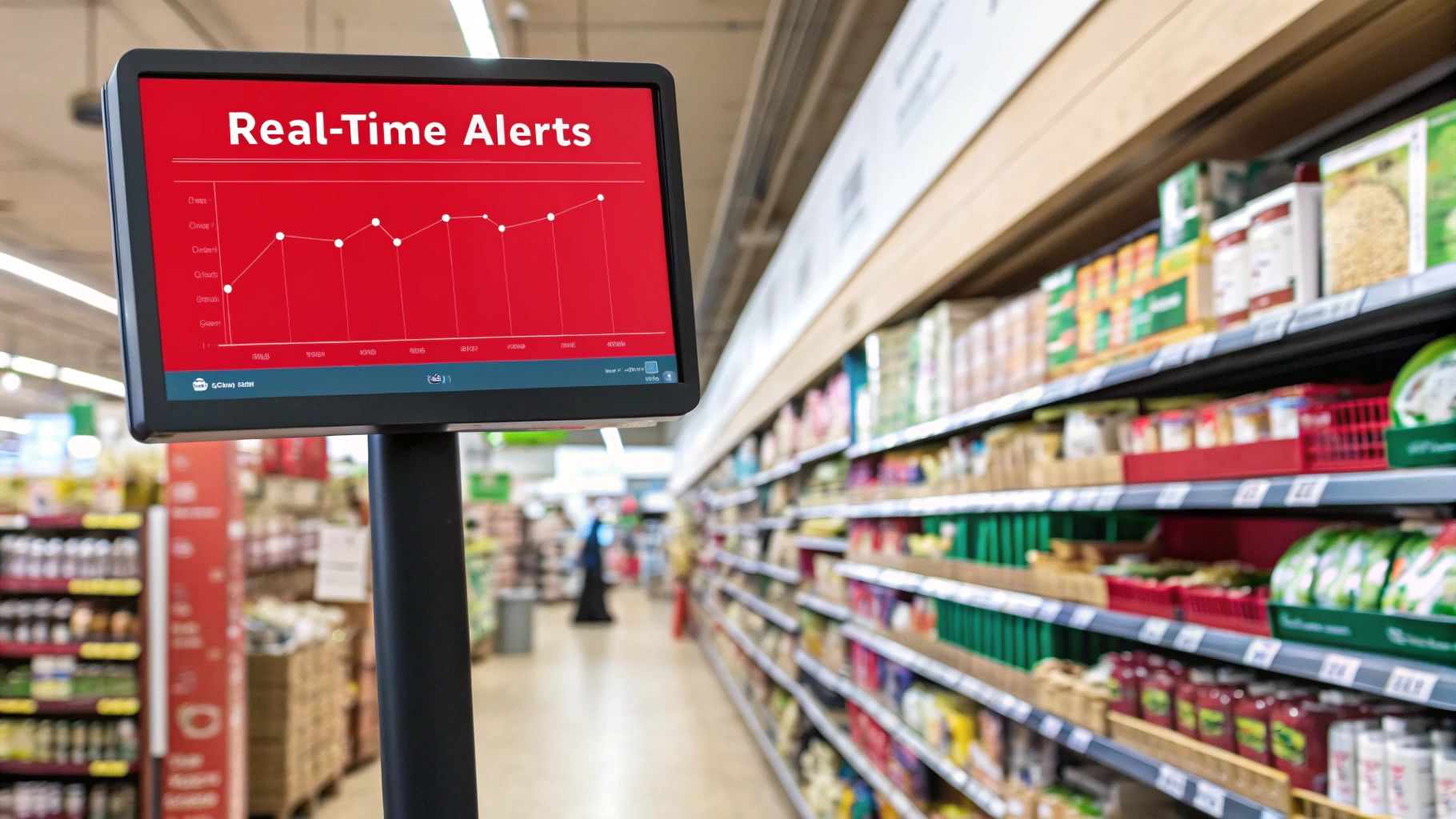
It’s one thing to understand the mechanics of a shelf tracking system, but it’s another thing entirely to see how it directly fuels business growth. When you adopt this technology, you’re not just counting items; you’re shifting your whole inventory strategy from reactive to proactive. It’s about making smarter, data-backed decisions that strengthen your entire operation.
The most immediate win? Near-perfect inventory accuracy. Traditional methods almost always have a gap between what the system says you have and what’s actually on the shelf. That gap is where sales are lost and customers get frustrated. Smart shelves close that gap for good.
From Manual Counts to Automated Efficiency
By giving you a live, continuous view of on-shelf availability, these systems make sure your most popular products are always there for your customers. This precision sends a ripple effect across the entire business, driving some serious ROI.
- Drastically Reduce Shrinkage: Automated tracking helps you pinpoint losses from theft, damage, or simple errors the moment they happen—not weeks later during a painful manual audit.
- Eliminate Manual Cycle Counts: Imagine freeing up your team from the tedious, soul-crushing task of counting stock. They can finally focus on what really matters: helping customers and making the store look great.
- Automate Restocking Workflows: The system can automatically trigger a restock order or ping an employee the second a product’s on-shelf count dips below a set level.
This is exactly why the smart shelves market is expected to explode to $16.69 billion by 2030. These aren’t just gadgets; they’re a fundamental shift in how retail works, combining smart sensors with software to give you real-time visibility.
A Real-World Scenario in Action
Let’s picture it: a popular brand of coffee is one of your top sellers. A customer grabs the very last bag off the shelf.
Instantly, the system knows. It sends an alert to both the stockroom and the purchasing manager. An employee gets a notification to restock the shelf from the back, while the system’s data logs the sale to inform the next supplier order.
This seamless loop ensures the shelf is never empty for long. You’ve just avoided a lost sale and kept a customer happy, all without anyone lifting a finger to count. The system doesn’t just track products; it actively maintains the flow of inventory to meet real-time demand.
This kind of power is a core advantage, much like the operational gains retailers see from other modern in-store tech. In fact, these systems work hand-in-hand with tools like electronic shelf labels. To see how it all fits together, you can check out the benefits of electronic shelf labels and how they complement a smart inventory setup.
By turning your shelves into intelligent, data-gathering assets, you can finally get a real handle on your inventory, cut down on waste, and build a much more resilient business.
Choosing the Right Shelf Tracking Technology
Picking the right shelf tracking system isn’t a one-size-fits-all deal. The tech that works wonders for a high-end electronics store would be total overkill for a busy grocery aisle. To make the right call, you have to match the technology to your specific products, your operational goals, and, of course, your budget.
Think of it like choosing a vehicle. A sleek sports car is fast and precise, but you wouldn’t use it to haul a load of bricks. In the world of shelf tracking, you’ve got three main “vehicles” to choose from: RFID, weight-sensing shelves, and vision-based systems. Each one shines in different situations.
RFID-Based Systems
Radio-Frequency Identification (RFID) is your go-to when you need pinpoint accuracy for every single item. By attaching a unique tag to each product, you get an incredible level of visibility into its exact location and status. This makes RFID a no-brainer for tracking high-value goods like electronics, pharmaceuticals, or designer apparel, where knowing the whereabouts of every last item is mission-critical.
Of course, that level of precision comes at a price. Tagging every individual product means investing in the tags themselves and the labor to get them on there.
Weight-Sensing Shelves
Picture a shelf that knows exactly how many cans of soup are sitting on it just by feeling their collective weight. That’s the simple but brilliant idea behind weight-sensing shelves. This approach is incredibly effective for tracking uniform, fast-moving consumer goods sold in huge quantities—think drinks, canned foods, or cleaning supplies.
For these high-volume items, weight-sensing systems are generally a more cost-effective route than individual RFID tags. The main catch? They can’t tell the difference between two products if they happen to weigh the same, which makes them less ideal for shelves stocked with a wide variety of mixed items.
Choosing the right technology hinges on a simple question: Do you need to track each specific item, or do you just need to know the quantity of a particular product? Answering this will quickly point you in the right direction.
Vision-Based Systems
The newest player in the game is vision-based shelf tracking. These systems use strategically placed cameras and powerful AI to literally “see” what’s on the shelf. They can instantly spot out-of-stocks, check if products are in the right place, and even catch pricing errors, all from a single image.
This approach gives you a ton of data that goes way beyond a simple inventory count, but it does require some seriously smart software to interpret all that visual information correctly. And as you’re looking at these high-tech systems, don’t forget the basics. Something as simple as using durable industrial labels for clear location and asset ID is foundational to making any system work smoothly.
Comparison of Shelf Tracking System Technologies
To help you visualize the trade-offs, let’s break down how these three technologies stack up against each other. Each has its own sweet spot when it comes to accuracy, cost, and the types of products it handles best.
| Technology Type | Accuracy Level | Relative Cost | Best For |
|---|---|---|---|
| RFID-Based | Very High (Item-Level) | High | High-value, individual items like electronics or jewelry. |
| Weight-Sensing | High (Quantity-Level) | Medium | Uniform, fast-moving products like beverages or canned goods. |
| Vision-Based | High (Multi-Factor) | Medium-High | Mixed merchandise, planogram compliance, and price verification. |
Ultimately, the best choice depends on what you’re selling and what you’re trying to achieve. Weighing these factors will guide you to the technology that delivers the most value for your specific retail environment.
Your Roadmap for a Successful Rollout
Bringing in a new technology like a shelf tracking system can feel like a massive undertaking. But with a smart, structured approach, what seems like a complex project becomes a manageable—and highly profitable—investment. Think of this as your roadmap to a smooth rollout that minimizes headaches and maximizes your return right from the start.
The journey doesn’t begin with picking tech; it starts with a hard look at your own operations. Before you even think about talking to vendors, you need to do a thorough needs assessment. Where are your biggest inventory headaches? Is it the constant stockouts of your best-sellers? Maybe it’s the unexplained shrinkage in one specific department, or just the sheer cost of paying staff for manual counts.
Getting this homework done first is non-negotiable. It gives you a concrete list of problems you need to solve and clear goals to measure your success against. This way, you end up choosing a system that actually fixes your real-world business challenges.
Start Small with a Pilot Program
Instead of jumping into a full-scale, store-wide deployment, the smarter move is to start with a small, controlled pilot program. This lets you test the technology in a real-world setting without putting your entire operation at risk.
Pick one department or a specific product category to be your test lab—ideally, one that’s a good example of the challenges you’re trying to solve. For a grocer, this might mean focusing on a single, high-turnover aisle. You can find more targeted strategies for how this technology helps different departments in our guide on smart systems for grocery stores. This limited trial will give you priceless feedback on how the system really performs, how user-friendly it is, and the true impact it has on your bottom line.
A pilot program is your proof of concept. It doesn’t just validate the technology; it helps get your team on board by showing them the benefits firsthand. That makes the eventual full-scale rollout a much easier sell.
Choosing a Vendor and Integrating the System
Once you have insights from your pilot, you’ll be in a much better position to pick the right vendor. The global market for smart shelving is booming and expected to hit around $3.592 billion soon, which means you have more choices than ever. This growth is being driven by the intense pressure from e-commerce and logistics for better, faster inventory management. If you want to dive deeper into this trend, you can read the full research on smart shelving growth.
Look for a partner who isn’t just selling you hardware. You need someone who offers seamless integration with the software you already use, like your Enterprise Resource Planning (ERP) or Point of Sale (POS) systems. This connectivity is everything. It’s what transforms raw data from the shelf into smart, actionable insights you can use across your entire business.
Finally, don’t ever forget the human side of the equation. The most advanced shelf tracking systems are useless if your team doesn’t know how to use them. A successful implementation lives or dies by the quality of your staff training. Make sure it covers:
- Daily Operations: How to use the system for everyday tasks like restocking and finding products.
- Reading the Data: How to actually understand the reports and alerts the system kicks out.
- Basic Fixes: Simple troubleshooting steps so they can handle common issues without calling for help.
When you invest in your team’s confidence, they’ll see the new system as a tool that genuinely makes their jobs easier. That’s the key to making sure the technology sticks.
The Future of Automated Inventory Management
Today’s shelf tracking systems are already making waves in retail, but honestly, we’re just scratching the surface. The real future lies in creating a truly predictive and self-managing inventory ecosystem. We’re talking about smart shelves that do more than just count what’s there—they’ll become proactive decision-makers.
This whole evolution is being supercharged by Artificial Intelligence (AI) and Machine Learning (ML). Picture a system that doesn’t just ping you when a product is running low. Instead, it’s crunching historical sales data, keeping an eye on local events, checking weather forecasts, and even monitoring social media trends to predict a spike in demand before it even happens. It can then automatically tweak reorder points and suggest the perfect stock levels, turning reactive restocking into a predictive science.
The Rise of the Connected Supply Chain
The next logical leap? Connecting these brainy shelves directly into the wider supply chain using the Internet of Things (IoT). In this future-state model, your shelves won’t just send an alert to an employee in the back. They’ll communicate directly with your supplier’s warehouse management system.
Imagine a popular item’s inventory drops to a critical level. The shelf itself could trigger a replenishment order, creating a seamless, automated flow of goods from the production line straight to the sales floor without a single human needing to get involved. This creates a self-optimizing ecosystem.
If you want to dive deeper into the strategies making this happen, this guide on automating inventory management is a great resource, offering practical insights into the tools and workflows shaping this future.
Ultimately, modern shelf tracking systems are more than just a fix for today’s operational headaches. They are the bedrock for building the next generation of intelligent, responsive, and ridiculously efficient retail and logistics environments. Getting on board now is the first step toward that fully automated future.
Frequently Asked Questions
Jumping into any new technology brings up a lot of questions. It’s totally normal. Getting straight answers is the only way to figure out how something like a shelf tracking system could actually work for your business and whether it’s the right move.
Let’s cut through the noise and tackle the most common questions head-on.
What’s This Going to Cost Me?
There’s no one-size-fits-all price tag for a shelf tracking system, and anyone who tells you otherwise isn’t giving you the full picture. The final cost really boils down to a few key things: the tech you pick (like RFID vs. weight-sensing shelves), how big of an area you need to cover, and just how many products you’re trying to keep an eye on.
Starting with a small pilot program in a single department is obviously going to be a lot cheaper than wiring up the entire store from day one. But it’s important to think of this as an investment, not just a cost. The return on that investment usually shows up pretty quickly by:
- Slashing labor costs when you no longer need to do manual inventory counts.
- Boosting sales because you’ve virtually eliminated those frustrating out-of-stock situations.
- Cutting down on shrinkage by spotting misplaced or stolen items in real time.
How Is This Different From Just Using Barcodes?
While both are used for inventory, they work in fundamentally different ways. Think of a barcode scan as a single, manual snapshot in time. Someone has to walk up, find the item, and get a direct line of sight to scan it. It’s a periodic check-up that’s only accurate for that one moment it happens.
A shelf tracking system, on the other hand, is like having a live, continuous video feed of your inventory. It works automatically, 24/7, monitoring what’s on the shelf without anyone needing to lift a finger. This hands-off approach gets rid of the manual work and gives you a constantly up-to-date, brutally honest picture of your stock.
Will Shelf Tracking Work for All My Products?
Not every tracking technology is the right fit for every single product, and that’s a critical piece of the puzzle. The best system for you really depends on what you’re selling.
For instance:
- RFID systems are fantastic for keeping tabs on high-value, individual items. Think electronics, jewelry, or designer apparel, where knowing the exact location of each specific item is a must.
- Weight-sensing shelves are the workhorses for uniform, fast-moving goods like canned soup, soda, or bags of chips. Here, the goal is simply knowing the quantity on hand, and these systems nail it.
- Vision-based systems are the versatile all-rounders. They’re great for aisles with mixed merchandise because they can identify different products, check if they’re in the right spot (planogram compliance), and even spot pricing errors all at once.
Article created using Outrank


Leave a Reply
Your email is safe with us.